







Download Serum for macOS
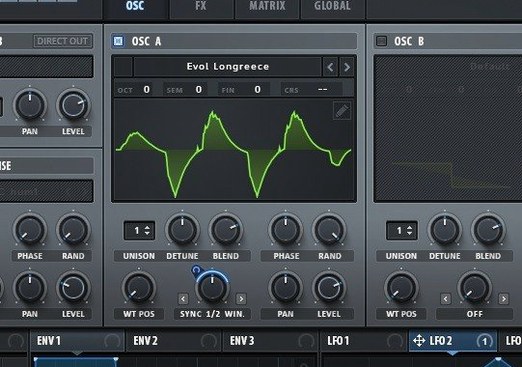
Assigning a completely different waveform to every single unison voice at once isn't something you see every day. Unison WT Pos does exactly that, and it reshapes how you think about thickening a patch. Instead of just copying one oscillator and detuning the copies, you get genuine timbral variation across the stack. A lead that shifts from a glassy digital wave to a rounded analog shape as voices spread apart sounds alive in a way simple detune tricks can't match.
Features Built for Sound Design
- Stack up to 16 voices on a single oscillator, then layer octaves and intervals so one key press fills the stereo field.
- Drive two filters in series or morph between them with the dual filter setup, shaping everything from surgical cuts to vocal-like sweeps.
- Push flangers, phasers, and comb filters that track the note you play, keeping modulation tight across the keyboard.
A Modulator That Follows the Music
Effects that know what note you're hitting change the whole workflow. When a comb filter or flanger locks to pitch, rhythmic cancellations stay musical instead of wandering off-key. You dial in a short resonant pluck down low, and the same setting works up high without adjustment. That note-tracking behavior ties the modulation engine to the harmony of your track, so presets translate across octaves with less fuss.
Producers who spend most of their time building patches from scratch tend to bond with Serum fastest. The wavetable editor invites you to draw harmonics, morph between imported single-cycle waveforms, or apply FFT-based processes that bend a basic saw into something unrecognizable. If you hear a bass stab in a track and immediately want to know how it was made, the visual feedback on every modulation routing pushes you toward answering that question yourself. Sound designers working on game audio or sample packs also lean hard on the unison stacking — layering four octaves of a texture and then assigning different wavetable positions to each voice spits out evolving beds that would take an hour to fake with separate instances.
On the other end, preset browsers who tweak rather than build still find plenty to grab. The factory library covers modern electronic genres well, and the macro system means a handful of knob turns can reshape a pluck into a pad without touching the modulation matrix. That said, someone who mainly needs a quick piano or string sound and rarely opens a synth's hood will feel the weight of features they won't use. Serum rewards curiosity, and the more you dig, the more it gives back.
Per-voice waveform variation beyond Vital
Vital shares the animated wavetable view and drag-and-drop modulation approach, and its spectral oscillator warp modes open creative doors Serum doesn't. But Serum's unison section pulls ahead when you need per-voice waveform variation — Vital's unison stays closer to traditional detune spreading. The filter roster in Serum also edges out with the note-tracking comb and dual-filter morphing, which Vital handles differently through its filter routing options.
Phase Plant takes a modular approach where you snap together generators and effects on a blank canvas. It feels more open-ended for building complex layered patches from scratch, but Serum's tighter focus on wavetable manipulation makes everyday editing quicker. Dragging a waveform in Phase Plant means navigating its sample mapper; in Serum, you drop it straight onto the oscillator and see the harmonics update instantly. For someone who lives inside wavetables, that immediacy matters.
Massive X leans harder into its dual wavetable oscillators and insert effects, and its raw tone has a weight some producers prefer for bass and low-mid material. Serum counters with a brighter, more forward character that cuts through dense mixes with less post-processing. The modulation system in Serum also feels more playful — drag a modulator onto any knob, set a range, and you're done. Massive X requires more menu diving to achieve the same routings.
16 voices and LFOTool-sourced filters
Version 2 brought a revamped oscillator section that doubled the voice count from eight to sixteen, which made unison patches noticeably thicker without stacking multiple instances. The filter additions — pulled in part from Xfer's LFOTool — gave producers access to comb filtering and dual-filter morphing that previously required external plugins or DAW routing tricks. Everyday sound design got faster because you can now audition filter types by scrolling instead of loading separate instances for comparison.
Performance improvements under the hood mean patches that used to spike CPU meters on older Intel Macs run more smoothly, especially when unison voice counts climb. The interface scaling got attention too; on Retina displays, the wavetable view stays sharp without blurring, and modulation animations feel snappier during playback. For anyone who grabbed a serum download mac build early on, the stability fixes since 2.0 smoothed out occasional crashes when rapidly switching between complex presets.
AU validation-free inside Logic Pro
Serum plays well inside Logic Pro's AU environment, showing up predictably in the instrument slot without the validation headaches some third-party synths cause. The drag-and-drop modulation pairs naturally with Logic's automation lanes — you can set a macro to control multiple parameters, then draw automation curves that sweep through entire patch transformations. Ableton Live users lean on the same macro system mapped to racks, turning Serum into a performance instrument where one knob morphs a bassline from subby to aggressive over four bars.
On the file-sharing side, Serum's preset format travels easily between collaborators. A folder of .fxp files zipped up and dropped into the presets directory loads instantly, and because the wavetable data embeds inside the patch, you don't chase down missing samples like you might with a sampler-based instrument. macOS's native Audio Unit support also means Serum slots into GarageBand for quick sketching, though the full feature set really shines in a DAW with flexible routing.
Offline, some producers still hunt for older builds through queries like xfer serum torrent or serum 2 download torrent to test on secondary machines, and the current version's architecture covers both Apple Silicon and Intel Macs in one install. That universal binary approach keeps things tidy — no separate downloads depending on which Mac you're sitting at. For those coming across a torrent serum 2 link, the patched build from Team V.R includes straightforward activation steps that replace the 15-minute demo limitation without extra hoops.
Version 2.1.5 is a big quality-of-life update that tidies up quite a few rough edges while adding clever new workflow touches. Here's what's changed:
- New option to restore parameter lock states when your host loads a project — great for picking up exactly where you left off.
- Right-click a modulation assignment and choose Show in Matrix to jump straight to that parameter in the modulation matrix.
- Mono voice mode now includes a setting that respects the sustain pedal, limiting a single note to one voice even when held.
- Scroll position in the effects rack is preserved when you switch between racks and tabs, so you no longer lose your place.
- Serum 2 effects now support stereo output even with a mono input — handy for widening mono sources with stereo effects.
- Scale tuning can now be applied to the Pitch Expression parameter for microtonal pitch bends.
- Envelope auto-zoom state is now saved and recalled.
- Hold Shift for finer adjustments when dragging modulation amounts and output levels.
- New theme colour parameters for active key and range displays in the oscillator view — makes custom skins feel more polished.
- Fixed arpeggiator notes cutting off when playback starts with tempo sync enabled.
- Fixed an issue loading Serum 1 presets where chaotic LFOs could incorrectly switch out of free-running mode.
- Fixed crashes when loading impulse responses shorter than 256 samples in the Convolve effect, and when loading default.fxp files.
- Fixed distortion when reading 32-bit PCM WAV files.
- Fixed Expression and Mono Aftertouch values not updating at note start in mono legato mode.
- macOS 10.13 or later
- Apple Silicon or Intel 64-bit
Questions people ask
Does Serum run natively on Apple Silicon Macs?
Yes, it supports both ARM and x86 64-bit Macs, so it runs natively on newer Apple Silicon machines.
What makes Serum's unison different from other synths?
With Unison WT Pos, you can assign a different wavetable waveform to each unison voice, creating rich timbral motion instead of simple pitch-spread copies.
Also on readers' docks
Sign in or create an account to leave a comment.
No comments yet. Tell me how it got on with your other devices.
More in VST Plugins
See all Serato Sample
2.2.0 VST Plugins
612 MB
 Serato Hex FX
1.2.0 VST Plugins
105 MB
 ShaperBox
3.6.1 VST Plugins
111 MB
 Scaler 3
3.3.2 VST Plugins
1.4 GB
 Sauceware Audio Scorch 2
1.0.4 VST Plugins
2 GB
 Slate Digital Fresh Air
1.0.9 VST Plugins
40 MB
 Slate Digital Murda Melodies
1.1.1 VST Plugins
179 MB
 Safari Pedals Everything Bundle
2026.05 VST Plugins
628 MB