








Download Slate Digital Murda Melodies for macOS
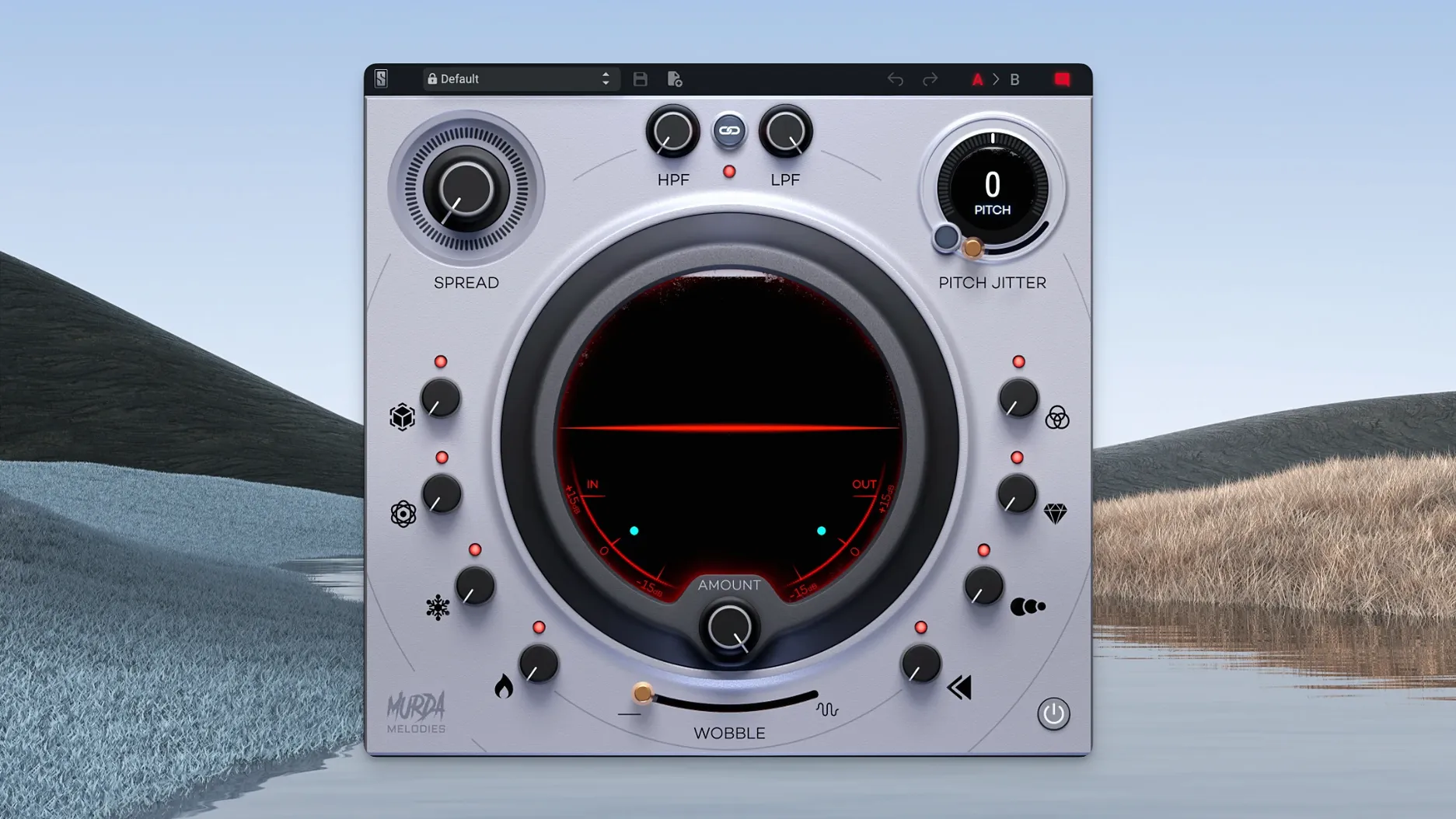
When a melody sits too clean in the mix, it can fight the groove instead of riding it. Murda Melodies is built to knock sounds off their predictable axis—pitching them into darker, wider, or weirder territory without stacking six plugins to get there. It’s a single-window effects rack tuned for the textures that hip-hop, trap, and R&B demand, from grimy pitch artifacts to reversed, syncopated ambience.
Compatibility comes first: the plugin runs on macOS 11 and later, with native Apple Silicon support so it won’t drag down a session through Rosetta. It ships in AU, VST, VST3, and AAX formats, covering Logic Pro, Ableton Live, FL Studio, and Pro Tools on a modern Mac. An earlier update (1.0.8) ironed out the default install path and added mono-to-stereo handling for AAX and AU, which means the stereo widener stays safe even when a mono vocal or synth line hits it.
What you actually get are eight knobs, each dialing in a distinct effect. Modulation, reverb, and synced delays cover the atmospheric side. The reverse processor flips phrases for ear-catching transitions, while the Pitch Jitter control introduces those wobbly, non-linear artifacts that make a melody sound sampled from worn-out vinyl. A mono-compatible stereo widener rounds out the set, letting you push a lead or ad-lib wide without collapsing in mono playback.
It’s a focused tool, not a bottomless effects suite—best for producers who want to twist a melody or vocal into something grittier and wider in a few quick moves.
A Melody-Degrading Workflow From Start to Finish
Let's say you've got a soft bell line that's too polite—it needs to sound like it was sampled off a cassette found in a basement. I start by loading Murda Melodies on the insert, then pull up the factory preset "Fractured Toys" as a jumping-off point. The hi-pass filter comes next: I sweep it up to around 400 Hz, shaving off the sub weight so the effect processing has room to breathe without turning muddy.
Now the real character work begins. I drop the pitch shifter down a full octave and blend it to about 40% wet, so the original and the pitched-down version sit side by side. A touch of Pitch Jitter—barely 15%—introduces that unstable, warble-heavy texture that makes the line feel less digital. From there I set the delay to an eighth-note sync and kill the feedback after two repeats, just enough to throw a ghost of the melody behind the dry signal. Last move: dial the stereo widener to around 11 o'clock, push the reverb into a short room, and the bell line now sounds like it's decaying through old gear in a damp studio. The whole chain took under a minute, no extra plugins needed.
Cranking Every Knob Turns Gold into Mush
The biggest trap is cranking every knob because they're all right there. Murda Melodies rewards restraint—when modulation, reverse, pitch shift, and vinyl wobble all run at full tilt, the output turns to indistinct smearing. Beginners also tend to ignore the hi-pass and lo-pass filters entirely, then wonder why a 808 or bass patch loses its punch the moment the plugin is active. Those filters are not decoration; they carve out the zone the effects occupy.
Another common slip: leaving the pitch shifter at extreme intervals without checking how it interacts with the song's key. A fifth or an octave usually works, but a minor second clashing against a lead vocal can wreck a mix fast. And unless you're after a lo-fi mono vibe, always verify the widener doesn't collapse the core of the sound when summed to mono—especially on kicks or bass synths that need to stay anchored in the center.
Zero Beach Balls Across Six Instances
On Apple Silicon the plugin loads instantly, even inside a session pushing 60-plus tracks. I've thrown it across a half-dozen instances—hi-hats, 808s, a vocal chop bus—and haven't seen a single beach ball. Memory usage stays modest: each instance hovers around what you'd expect from a single reverb or delay, not a multi-gigabyte instrument. That means you can sprinkle it across a project without preemptively freezing tracks.
Stability has been rock-solid through Logic 10.8 and Ableton Live 11.3. No crashes when swapping presets mid-playback, no clicks when bypassing individual effects. The GUI refreshes smoothly even on a scaled Retina display, and automation writes cleanly for every parameter. If you've grabbed a murda melodies free download to test before committing, you'll notice the performance difference right away compared to stacking three separate modulation utilities—the whole eight-knob engine barely nudges the CPU meter.
- macOS 11 or later
- Apple Silicon native support
- AU, VST, VST3, or AAX host
Questions people ask
Does Murda Melodies work natively on Apple Silicon Macs?
Yes. The plugin offers native Apple Silicon support, so it runs without Rosetta translation on M-series chips running macOS 11 or later.
What plugin formats does Murda Melodies include on Mac?
It ships in AU, VST, VST3, and AAX formats, covering most major DAWs on macOS.
Is the stereo widener in Murda Melodies mono-compatible?
Yes. Version 1.0.8 added mono-to-stereo compatibility in AAX and AU formats, so the widener works safely on mono sources.
Also on readers' docks
Sign in or create an account to leave a comment.
No comments yet. Tell me how it got on with your other devices.
More in VST Plugins
See all Slate Digital Fresh Air
1.0.9 VST Plugins
40 MB
Slate Digital Fresh Air
1.0.9 VST Plugins
40 MB
 Slate Digital Storch Filter
1.0.6 VST Plugins
69 MB
Slate Digital Storch Filter
1.0.6 VST Plugins
69 MB
 Slate Digital Submerge
1.0.5 VST Plugins
38 MB
Slate Digital Submerge
1.0.5 VST Plugins
38 MB
 Updated Sonic Academy KICK
1.1.8 VST Plugins
358 MB
Updated Sonic Academy KICK
1.1.8 VST Plugins
358 MB
 ShaperBox
3.6.1 VST Plugins
111 MB
ShaperBox
3.6.1 VST Plugins
111 MB
 Updated Serum
2.0.24 VST Plugins
30 MB
Updated Serum
2.0.24 VST Plugins
30 MB
 Spire
1.5.19 VST Plugins
158 MB
Spire
1.5.19 VST Plugins
158 MB
 Serato Sample
2.2.0 VST Plugins
612 MB
Serato Sample
2.2.0 VST Plugins
612 MB