








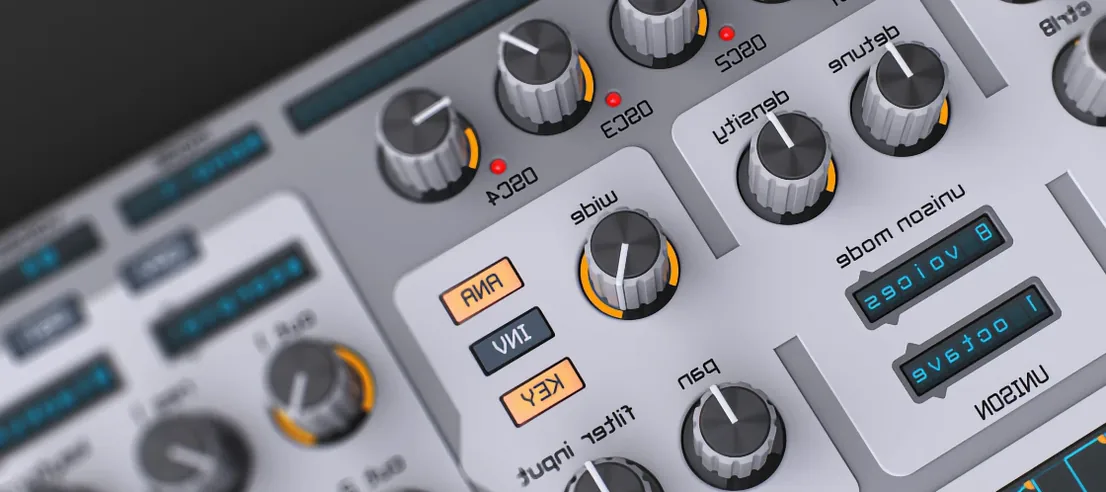
Download Spire for macOS
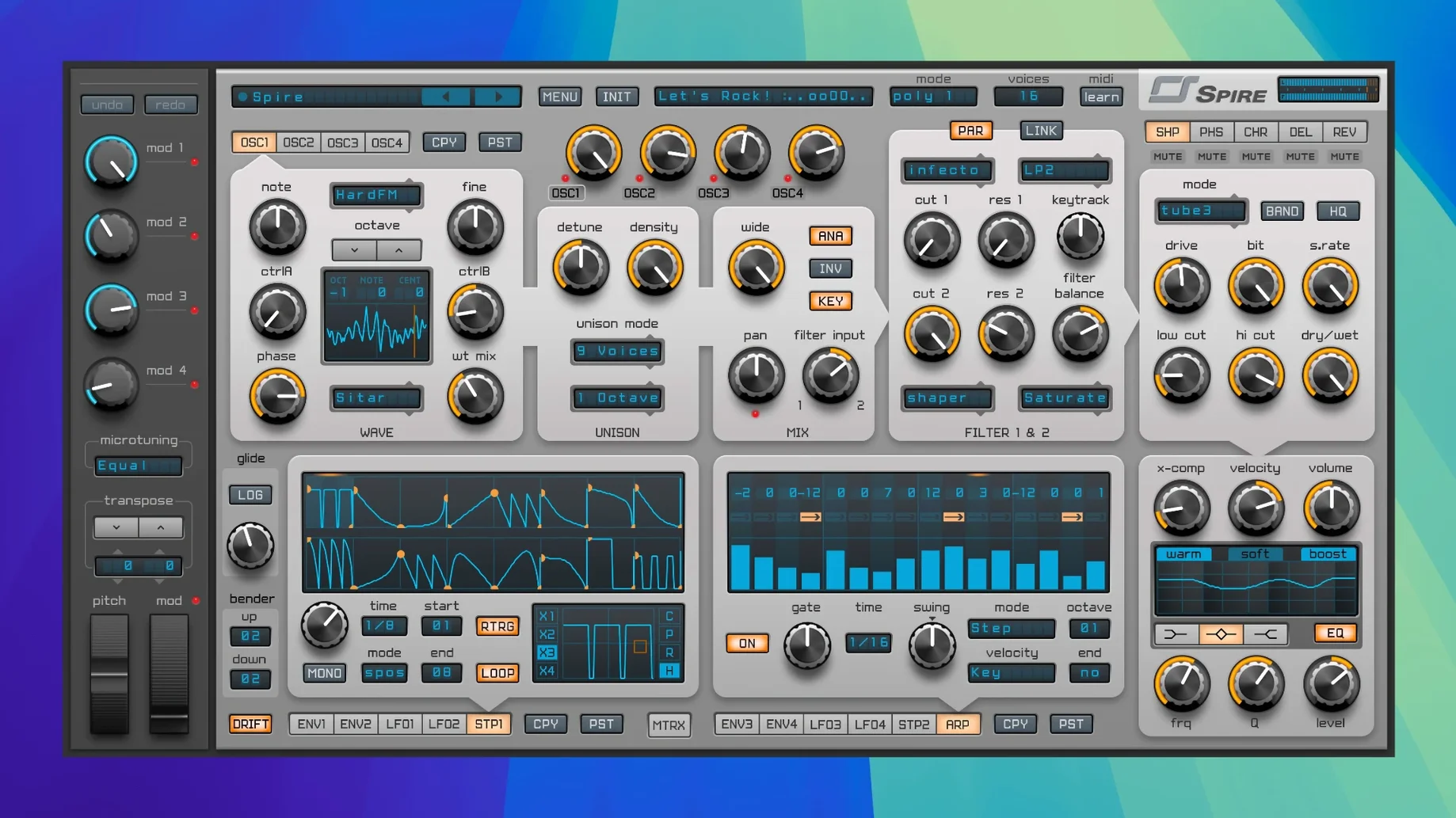
Hit the Shaper mode on oscillator one and pull the mix just past noon. Spire's polyphonic engine immediately shows its hand — rich, moving, and ready for a track.
Terms to Know
Shaper — a waveshaping oscillator mode that adds harmonics without using a filter. It's a fast way to turn a simple saw into something aggressive and present.
Unison Voices — Spire lets you stack up to 9 voices per oscillator with independent detune and spread controls. Crank it to 5 or 7 on a super saw patch and you'll hear the width that made it a staple in trance and house.
Modulation Matrix — a grid where you route 2 LFOs and 2 ADSR envelopes to almost any destination. Drag an LFO onto the filter cutoff, set it to a slow triangle, and the patch breathes.
Multimode Filter — switchable between 12 and 24 dB slopes with low-pass, high-pass, band-pass, and notch modes. The 24 dB low-pass ladder model is a sweet spot for plucks and basses.
After that, browse the 1500-plus presets. The factory library covers everything from dubstep growls to shimmering pad stacks, and each one is a lesson in how the synth's pieces fit together.
How Spire Stacks Up Against the Competition
Put Spire next to something like Serum, and the philosophy difference shows fast. Serum lives inside its wavetable editor — you drag nodes, import images, and build sounds from scratch. Spire takes a different path. Its four oscillators lean harder on classic virtual analog shapes, then push them through the Shaper and a filter section that sounds genuinely good. Serum can do convincing analog, but it takes work. Spire starts there and adds wavetables as an option, not the whole identity.
Sylenth1 is the closer relative, and a lot of producers have run both side by side for years. Sylenth1 strips things down to four oscillators and a dead-simple layout. It excels at being light on CPU and instantly musical. Spire brings more modulation muscle — two LFOs, two ADSRs, a full matrix — plus a step sequencer and arpeggiator that Sylenth1 simply doesn't have. The trade-off is that Sylenth1 loads faster and hits the CPU meter more gently. If you want a broad preset library and a synth that rewards digging into modulation, Spire pulls ahead. If you want a bass patch in under a minute and the lowest possible overhead, Sylenth1 still makes its case.
Dune 3 enters the conversation when you need layering at scale. It can stack eight synths inside a single patch and supports MPE, which Spire doesn't. But Dune's interface sprawls where Spire's stays compact. For a producer building trance leads or house stabs, Spire often feels quicker to navigate — everything visible on one screen, no tab-switching required.
Building a Pluck from Scratch
Here's a workflow I've settled into when a track needs a tight, rhythmic pluck — the kind that sits cleanly above a bassline without fighting the kick.
1. Initialize the patch. Right-click the preset name and choose Init. You get a single saw wave, no effects, no modulation routed.
2. Set oscillator one. Keep the mode on Classic, waveform on saw. Transpose it up an octave — plucks need presence, and the extra brightness helps later.
3. Shape the amp envelope. Switch to Env 1 (hardwired to amplitude). Attack at zero, decay around 400 ms, sustain at zero, release around 200 ms. The short decay with zero sustain gives the pluck its body without tail.
4. Filter it down. Route the signal to Filter 1. Pick the 24 dB low-pass ladder. Drag cutoff down to about 400 Hz, then head to the modulation matrix. Route Env 1 to filter cutoff with an amount of roughly 60 percent. Now the filter opens and closes with the amplitude shape, which tightens everything.
5. Add stereo width. Turn on unison for oscillator one. Set voices to 4, detune to 30 cents, spread to 80 percent. The pluck widens without losing its transient snap.
6. Layer oscillator two. Enable oscillator two, set it to a sine wave, same octave. Lower its volume to about 40 percent in the mixer. This fills out the fundamental without muddying the attack.
7. Apply effects. Send the whole thing through the internal reverb — small room, mix around 25 percent, decay short. Then add a touch of delay synced to 1/8 notes, feedback low. The pluck now moves across the stereo field while staying rhythmic.
Save the patch, throw it into a drum pattern, and tweak the filter cutoff to match the key of your track. The whole process takes under five minutes once you know the routing.
Dial In Warmth and Master Tune Early
Out of the box, Spire's defaults are sensible, but a few tweaks make everyday use smoother.
- Master Tune and Warmth. In the top bar, the Warmth knob adds subtle saturation before the output stage. I set it to 12–15 percent as a default. It's not drastic — just a gentle rounding that softens high-frequency harshness on bright patches.
- Oscillator phase reset. Buried in the oscillator settings, this forces the waveform to start at zero on every note-on event. Turn it on for bass sounds that need consistent attack transients. Leave it off for pads where the randomness sounds more natural.
- Filter key tracking. The filter defaults to no keyboard tracking. For leads and basses, set it to 50–70 percent so the filter opens as you play higher, keeping the timbre balanced across the keyboard.
- Arpeggiator latch mode. If you use the arpeggiator regularly, switch it to Latch. Spire's sequencer holds the notes without needing a MIDI hold pedal, which makes auditioning patterns much less frustrating.
Apple Silicon Loads Heavy Presets in Under Two Seconds
On an Apple Silicon machine, Spire 1.5.19 loads quickly — usually under two seconds even with a heavy preset that stacks all four oscillators and the full effects chain. Intel Macs from the last five years handle it fine, though older quad-core machines will feel unison-heavy patches more. A nine-voice super saw with delay and reverb can push a single core toward 30–40 percent on an older i7, so bouncing to audio remains a sensible habit for dense projects.
Stability has been uneventful, which is exactly what you want from a synth you reach for on deadline. Across Logic Pro, Ableton Live, and FL Studio on macOS, I haven't seen Spire crash a session. The plugin recovers cleanly from sleep and handles rapid preset changes without audio dropouts — something not every synth in this class manages. The MORiA build for 1.5.19 installs smoothly and activates without fuss, and the VST3 and AU versions both appear reliably in their respective hosts.
Memory use sits around 200–300 MB with a typical patch loaded, climbing toward 500 MB if you're running multiple instances with heavy reverb tails. That's reasonable for what it does, and the trade-off is a sound engine that's stayed relevant. Hunt for Spire VST crack Mac or a Spire torrent and you'll find plenty of chatter about this version — people keep coming back because the core experience holds up. If you've grabbed a Spire Mac torrent and want to know whether it'll hold under real session pressure, the answer is yes, provided your machine meets the 10.13 baseline.
- macOS 10.13 or later
- Runs on Intel and Apple Silicon Macs
- English interface
Questions people ask
Which genres does Spire work best for?
It's widely used in EDM, trance, house, and dubstep thanks to its thick unison engine and fast envelopes.
What modulation sources does Spire include?
It has 2 LFOs and 2 ADSR envelopes, all routable through a modulation matrix for custom patch movement.
Also on readers' docks
Sign in or create an account to leave a comment.
No comments yet. Tell me how it got on with your other devices.
More in VST Plugins
See all Updated Sonic Academy KICK
1.1.8 VST Plugins
358 MB
Updated Sonic Academy KICK
1.1.8 VST Plugins
358 MB
 Steinberg SpectraLayers Pro
13.0.20-All-in-One VST Plugins
3.9 GB
Steinberg SpectraLayers Pro
13.0.20-All-in-One VST Plugins
3.9 GB
 Slate Digital Submerge
1.0.5 VST Plugins
38 MB
Slate Digital Submerge
1.0.5 VST Plugins
38 MB
 Slate Digital Storch Filter
1.0.6 VST Plugins
69 MB
Slate Digital Storch Filter
1.0.6 VST Plugins
69 MB
 Slate Digital Murda Melodies
1.1.1 VST Plugins
179 MB
Slate Digital Murda Melodies
1.1.1 VST Plugins
179 MB
 Slate Digital Fresh Air
1.0.9 VST Plugins
40 MB
Slate Digital Fresh Air
1.0.9 VST Plugins
40 MB
 Superior Drummer
3.4.4 VST Plugins
625 MB
Superior Drummer
3.4.4 VST Plugins
625 MB
 Supertone Air
1.0.1 VST Plugins
408 MB
Supertone Air
1.0.1 VST Plugins
408 MB