








Download TouchDesigner for macOS
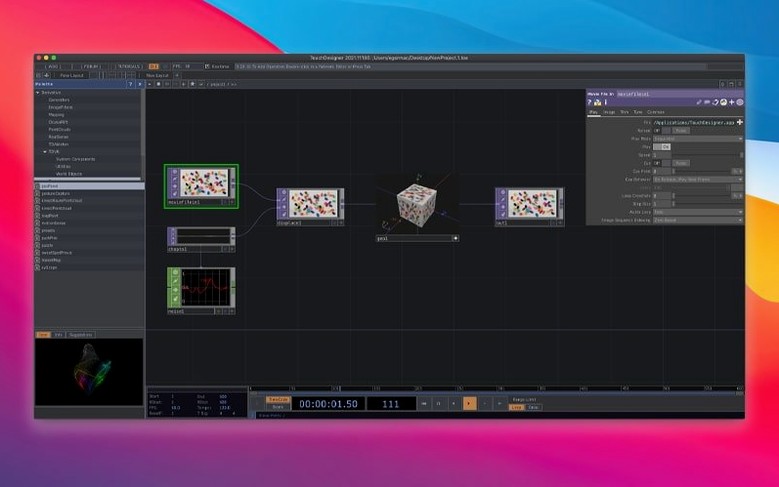
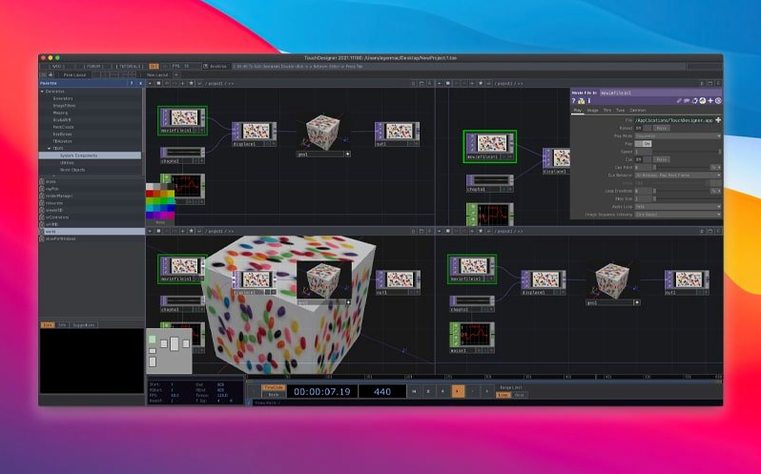
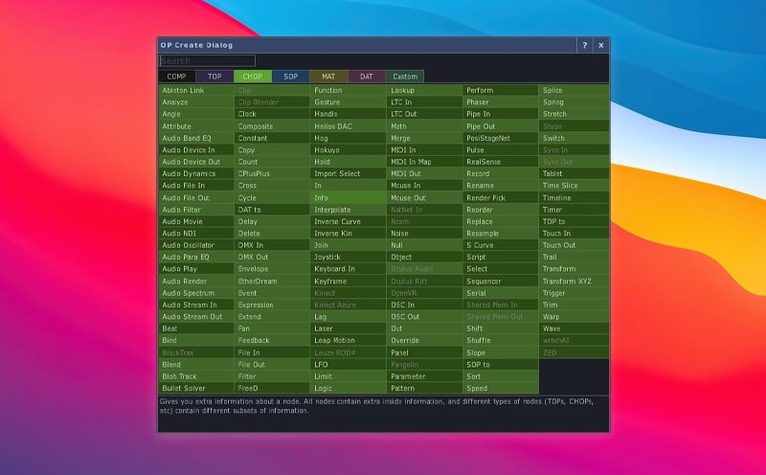
TouchDesigner is a node-based visual development platform where you build interactive real-time graphics, projections, and generative art by wiring together operators instead of writing reams of code.
What's a fun first project after the touchdesigner mac download?
Open a new project, lay down a Movie File In TOP, a Noise TOP, and a Composite TOP, then connect them. Feed a bit of moving video through a real-time displacement map—it's the quickest way to see pixels dance and get a feel for signal flow without touching a single line of script.
Which new operators should I play with immediately?
Drag in one of the fresh Point Operators, or POPs, introduced in this build. Point clouds feel properly native now, and you can chain a POP with the built-in VR tools to step inside your creation and walk around it.
I'm into live shows. Where do I start?
Patch a MIDI Controller In CHOP to a couple of parameters on a Phong MAT, then set the Window COMP to fullscreen on a second display. TouchDesigner talks to lighting desks, audio rigs, and show-control kit right out of the box, so even a simple knob-twist-to-camera-move setup teaches you a workflow that scales up to a full club night or theater run.
Can I make something that works with my existing gear?
Absoluteley. If you have an Intel Mac and an Orbbec depth sensor, the updated SDK hooks right in. You can build both your application's logic and its on-screen interface inside the same canvas, customizing everything for the hardware sitting on your desk.
Stop Cooking Your GPU with Unnecessary Calculations
Everyone does it: you wire twenty nodes together, hit play, and your frame rate drops to single digits. The first instinct is to blame the machine, but the real culprit is almost always cooking the GPU with unnecessary calculations. The most common rookie slip is leaving cook mode on "Always" for every operator. Switch anything that doesn't need per-frame updates to "On Demand" or "On Specified Cook" and watch your performance come back to life.
Another trap is ignoring the Info CHOP. Beginners will stare at a flickering number in a panel, wondering why a value drifts, when dropping an Info CHOP onto their chain would tell them exactly what the system sees. Similarly, newcomers often wire audio into a CHOP and forget to set the sample rate to match their sound card, then scratch their heads over crackle or drift. A quick glance at the Audio Device Out CHOP's rate parameter fixes it.
Oh, and the big one? Diving into a touchdesigner torrent or a touch designer torrent from some forum and expecting the project file to just work. Derivative's builds are particular about version matching, and random project archives floating around rarely bundle the custom components or third-party DLLs they depend on. It's a classic recipe for missing OP errors and an afternoon of detective work—so set aside some time to manually gather dependencies and check your build number.
Fix the Black Screen on Export Problem
The black screen on export problem haunts even experienced users. You build something gorgeous in the network editor, then your exported movie file is just darkness. Nine times out of ten, the Movie File Out TOP is pointing at a null render buffer because you forgot to set its input to the correct panel or perform mode output. Trace your cable one node upstream and you'll spot the gap.
On Intel Macs, you might find the Orbbec sensor refuses to show up even after the SDK upgrade. The usual suspect is macOS's privacy permissions. Head into Security & Privacy, check the camera and USB access lists, and make sure TouchDesigner appears there. A restart of the app after granting permissions is mandatory—the system won't hand over the feed until you relaunch.
Then there's the spaghetti network problem. You open a project you built at 2 AM and the canvas looks like a plate of neon noodles. The fix isn't just dragging nodes around; it's learning to use Base COMPs and Container COMPs early as tidy boxes. Right-click a cluster of related nodes, select "Collapse Selected," and suddenly your logic has a labeled, reusable home. Future-you will be grateful.
If you ever grabbed a touchdesigner crack or a touchdesigner crack mac build from a sketchy source, you've probably seen the cryptic "license check failed" dialog mid-project. That's just the build phoning home and finding a mismatch, which is totally normal for these versions. To avoid unexpected freezes during live gigs, make sure you run a quick offline test session first to let everything settle in.
One-Person Visualists Running Live Performances
Visualists running small-to-mid-scale live performances find their sweet spot here. If you're one person handling projections for a theater piece or a band's set, the ability to build both the control UI and the output canvas in one file means you don't need a second machine running a separate control app. You pre-program your cues, drop a Button COMP on a touchscreen, and run the whole show from backstage.
Installation artists who camp out in a gallery for two weeks also thrive with it. TouchDesigner's real-time nature means you tweak a noise pattern or a color ramp while standing in the space, seeing the change on the wall instantly. Combine that with the built-in projection mapping tools, and you're iterating on-site without bouncing between three different applications and a render queue.
Musicians and sound designers who already own an Intel Mac and some MIDI controllers get a surprising amount of mileage too. The deep CHOP system means you can treat a kick drum signal as a variable that drives particle birth rates, or map a synth's filter cutoff to the rotation of a 3D object. It's not just visuals reacting to audio; it's a two-way conversation where your gear and your graphics push each other.
Middle-Click a Node's Output Dot to Preview Any TOP
- Middle-click a node's output dot to drop a little preview panel right there on the canvas. You don't need to route everything to a perform window just to see what a TOP is spitting out.
- Shift + right-click drag pans the network editor. No more chasing the scroll bars with your cursor when your project sprawls sideways.
- Press "h" with a node selected to home your view on it. In a dense network, this is a life-saver for snapping instantly to a lost operator.
- The Text DAT can live-edit scripts while your project runs. Double-click it, type some Python, and see the result without stopping the timeline or recompiling anything.
- Bookmarks (Ctrl+Shift+B or Cmd+Shift+B) let you save and jump between zoomed-in views of your canvas. Place one on your UI controls, another on your 3D render chain, and bounce between them like browser tabs.
- Drag a .tox file from Finder straight onto the network to import a component. No navigating through the OP Snippets menu; just drop it and keep wiring.
The built-in VR tools also have a quiet shortcut: if you're prototyping for a headset and don't want to strap it on every thirty seconds, you can set the VR View TOP to preview mode and navigate with a mouse. It's not the same as being inside, but it saves your neck during layout passes.
The 2025.31550 release brings a fresh family of point operators into the mix and widens texture handling across the board:
- Point Operators (POPs) join the lineup for native point-cloud work.
- Most TOPs now support 3D textures and 2D arrays natively.
- The Orbbec SDK jumps to 1.10.16 for deeper sensor integration.
- macOS 10.14 or newer
- Intel-based Mac
- English interface
Questions people ask
Is TouchDesigner actually stable for real-world production on a Mac?
Yes—Derivative ships official builds as production-ready, tested, and stable, and they keep companion hardware wrappers like the Kinect Azure wrapper current.
Does TouchDesigner let me customize the user interface I show to an audience?
Absolutely. You build both the application logic and the end-user interface in a single environment, extending things to fit the project rather than bending your idea to fit the tool.
Also on readers' docks
Sign in or create an account to leave a comment.
No comments yet. Tell me how it got on with your other devices.
More in CAD & 3D
See all Vectorworks
2025 Update 7 v30.7.0 CAD & 3D
421 MB
Vectorworks
2025 Update 7 v30.7.0 CAD & 3D
421 MB
 Updated Sweet Home
7.5.7 CAD & 3D
356 MB
Updated Sweet Home
7.5.7 CAD & 3D
356 MB
 SketchUp Pro
26.2.242 CAD & 3D
1.6 GB
SketchUp Pro
26.2.242 CAD & 3D
1.6 GB
 Session Pomodoro Focus Timer
2.13.48 CAD & 3D
50 MB
Session Pomodoro Focus Timer
2.13.48 CAD & 3D
50 MB
 Rhino
8.30.26103.11002 CAD & 3D
760 MB
Rhino
8.30.26103.11002 CAD & 3D
760 MB
 Plasticity
26.1.3 CAD & 3D
256 MB
Plasticity
26.1.3 CAD & 3D
256 MB
 Pixologic Zbrush
2026.2.1 CAD & 3D
3.1 GB
Pixologic Zbrush
2026.2.1 CAD & 3D
3.1 GB
 Maya
2027.2 CAD & 3D
5.3 GB
Maya
2027.2 CAD & 3D
5.3 GB