









Download UJAM Symphonic Elements STRIIIINGS for macOS
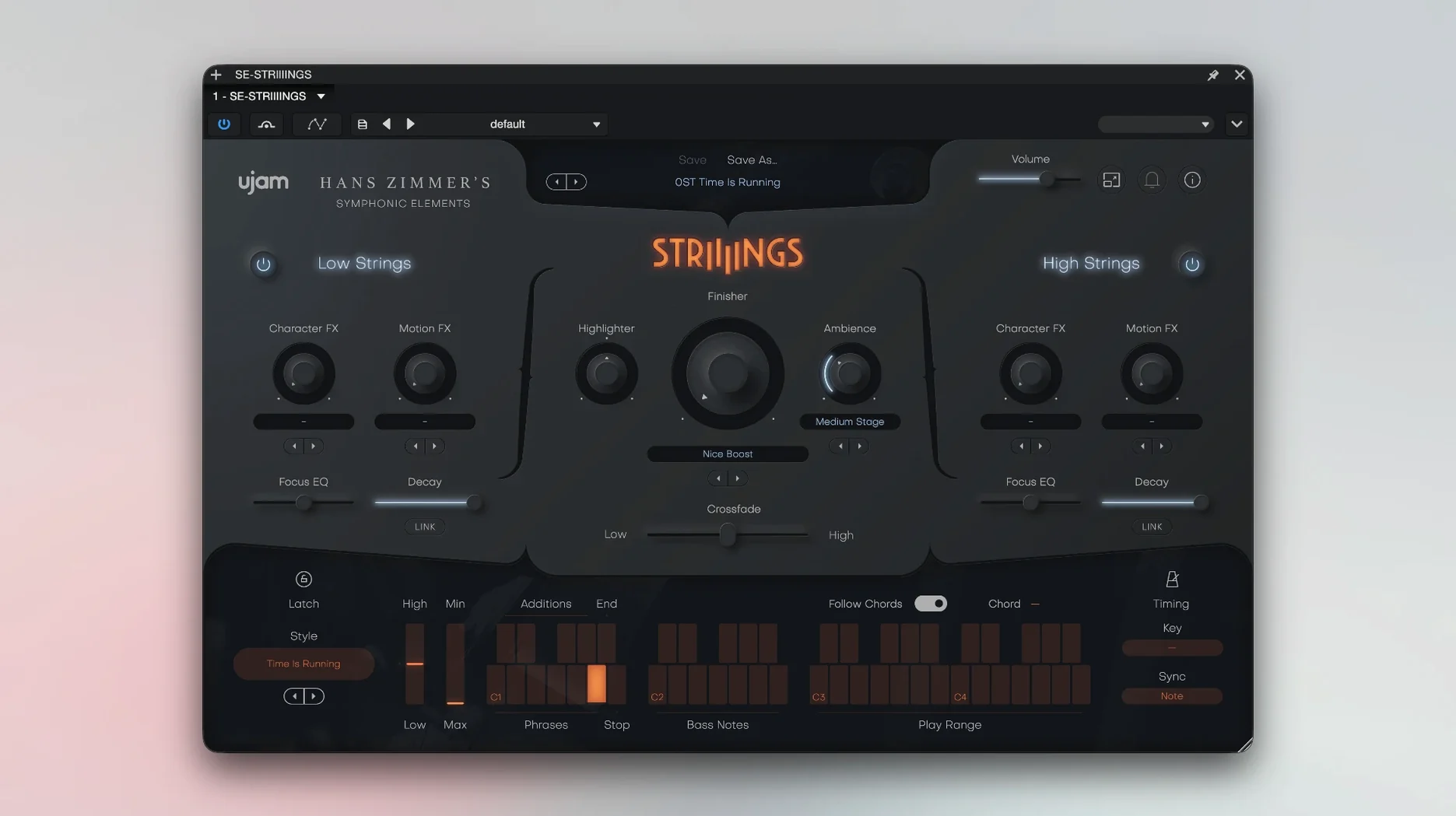
1. The instrument track: choose a style
Crossfade is the heart of it. You land on a patch and immediately start nudging the blend between the high-string sections — violins on one side, violas on the other. Sixty styles ship with the plug-in, and each one reshapes the character before you touch a single effect. For a cue that needs motion, I'll often ride the crossfade in real time rather than drawing automation later.
2. A send to the long reverb
STRIIIINGS sounds big out of the box, so my usual move is to send it to a dedicated cinematic hall on a bus. The built-in sound-design engine already packs a sense of space, but ducking the dry signal slightly and letting the bus carry the tail glues it into an orchestral session without washing out the attacks. The 64-bit Apple Silicon build keeps the roundtrip latency low, even in a Logic session that already has a dozen instances running.
3. The sound-design layer
Beyond straight string parts, the plug-in doubles as a texture machine. I'll duplicate a melodic line, flip to a darker style, and tuck it underneath as a pad. Because it's a single instrument with a focused voice — UJAM's first in the Symphonic Elements series — it never fights for room against brass or woodwinds the way a full ensemble library might.
Where it earns its keep is on deadlines. You get a convincing string-section gesture in seconds, and the DAW support is broad enough that it slots into any setup, from Reaper to Bitwig.
Building a tense undercurrent from silence
Yesterday I needed a tense undercurrent for a short film cue — nothing melodic, just shifting weight behind a piano figure. I opened Logic, created a software instrument track, and dropped STRIIIINGS onto the slot. The first thing I did was hold a low C and sweep through half a dozen styles with the crossfade parked dead center. Style 14 grabbed me — a brooding, bow-heavy texture where the low strings were doing most of the emotional heavy lifting.
Next I nudged the crossfade about thirty percent toward the High Strings side to let a sliver of viola air through. That was the moment the part stopped sounding like a pad and started sounding like a section breathing. I played in a simple two-note swell, quantized loosely, and sent it to a Valhalla room on bus 4. The whole process — from picking the plug-in to having a usable part printed — took under four minutes. That speed matters when the director is messaging you asking for a revision before lunch.
A drone-to-crescendo workflow
One task where STRIIIINGS really shines is building a long, evolving drone that crests into a reveal. Here's the chain I settled on after a few projects:
- Load a dark, motion-heavy style — something with built-in bow changes and movement.
- Pull the Low Strings level up a couple of dB and roll off a touch of top end with the tone control.
- Automate the crossfade parameter slowly from Low to High over eight or sixteen bars. The shift from celli-and-basses to violins-and-violas creates a natural brightening that feels like an orchestral sunrise.
- Layer in a second instance with a glassier style, mixed low, just to add a shimmer on the top third of the stereo field.
By the time the crossfade reaches the High Strings side, the part has transformed without a single key change. I've used this trick on two game trailers now, and both times the director assumed I'd layered three different libraries. I hadn't — it was one plug-in, two instances, and about ten minutes of riding faders.
Six instances deep on an M1 Max
On an M1 Max MacBook Pro, a single instance barely registers in Activity Monitor — the 64-bit Apple Silicon build is lean. When I push it harder and stack six or seven instances inside a Logic session that already has a full rhythm section and three synth tracks, the fan stays quiet and the buffer stays at 128 samples without complaint. On an older Intel machine running macOS Monterey I noticed slightly longer first-load times when opening the plug-in the initial time in a session, but after that it settles in and playback is smooth.
RAM usage stays modest — well under the prescribed 4 GB even with multiple instances, though I wouldn't run it on a machine with only 8 GB total if you're also hosting a heavy sample library. In daily work it's one of those tools that just sits there and behaves. No crashes, no sudden CPU spikes when you switch styles mid-playback, no authentication hiccups once it's up and running. The only quirk worth knowing: the very first time you launch it after installing, you need to open the plug-in, close it, and open it again. After that single ritual it's ready every time.
For anyone hunting down UJAM Symphonic Elements STRIIIINGS or even a UJAM torrent that actually works on Apple Silicon, the real story is simpler than the search trails suggest — this is a focused instrument that stays out of your way and delivers cinematic string weight without the orchestral baggage.
- macOS 10.14 or newer
- Apple Silicon or Intel Mac
- 64-bit plug-in host
- 4 GB RAM
Questions people ask
Which string sections does STRIIIINGS cover?
The High Strings engine covers violins and violas, and you blend between them with the Crossfade control.
What DAWs does the plug-in work with?
It runs in all major hosts including Ableton Live, Logic, Pro Tools, FL Studio, Cubase, Studio One, Bitwig, Reaper, and Reason.
Does it run natively on Apple Silicon Macs?
Yes, the plug-in is a 64-bit build that supports both Apple Silicon and Intel Macs, requiring macOS 10.14 or later.
Also on readers' docks
Sign in or create an account to leave a comment.
No comments yet. Tell me how it got on with your other devices.
More in VST Plugins
See all uJAM Cinedream
1.0.1 VST Plugins
3.5 GB
uJAM Cinedream
1.0.1 VST Plugins
3.5 GB
 UnderTone Audio UnFairchild
1.0.8 VST Plugins
220 MB
UnderTone Audio UnFairchild
1.0.8 VST Plugins
220 MB
 UJAM Beatmaker VICE
2.4.0 VST Plugins
262 MB
UJAM Beatmaker VICE
2.4.0 VST Plugins
262 MB
 Valhalla DSP Bundle
2025.12 VST Plugins
61 MB
Valhalla DSP Bundle
2025.12 VST Plugins
61 MB
 VocalNet
1.0.4 VST Plugins
669 MB
VocalNet
1.0.4 VST Plugins
669 MB
 VocalSynth 2
2.6.1 VST Plugins
259 MB
VocalSynth 2
2.6.1 VST Plugins
259 MB
 Toontrack EZmix Bundle
3.2.2 VST Plugins
977 MB
Toontrack EZmix Bundle
3.2.2 VST Plugins
977 MB
 Toontrack EZkeys
2.1.5 VST Plugins
707 MB
Toontrack EZkeys
2.1.5 VST Plugins
707 MB