








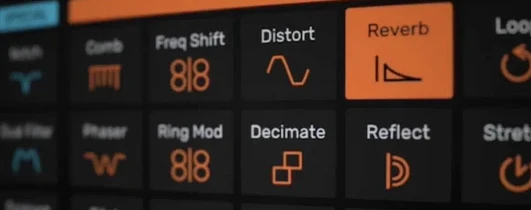
Download Devious Machines Infiltrator for macOS
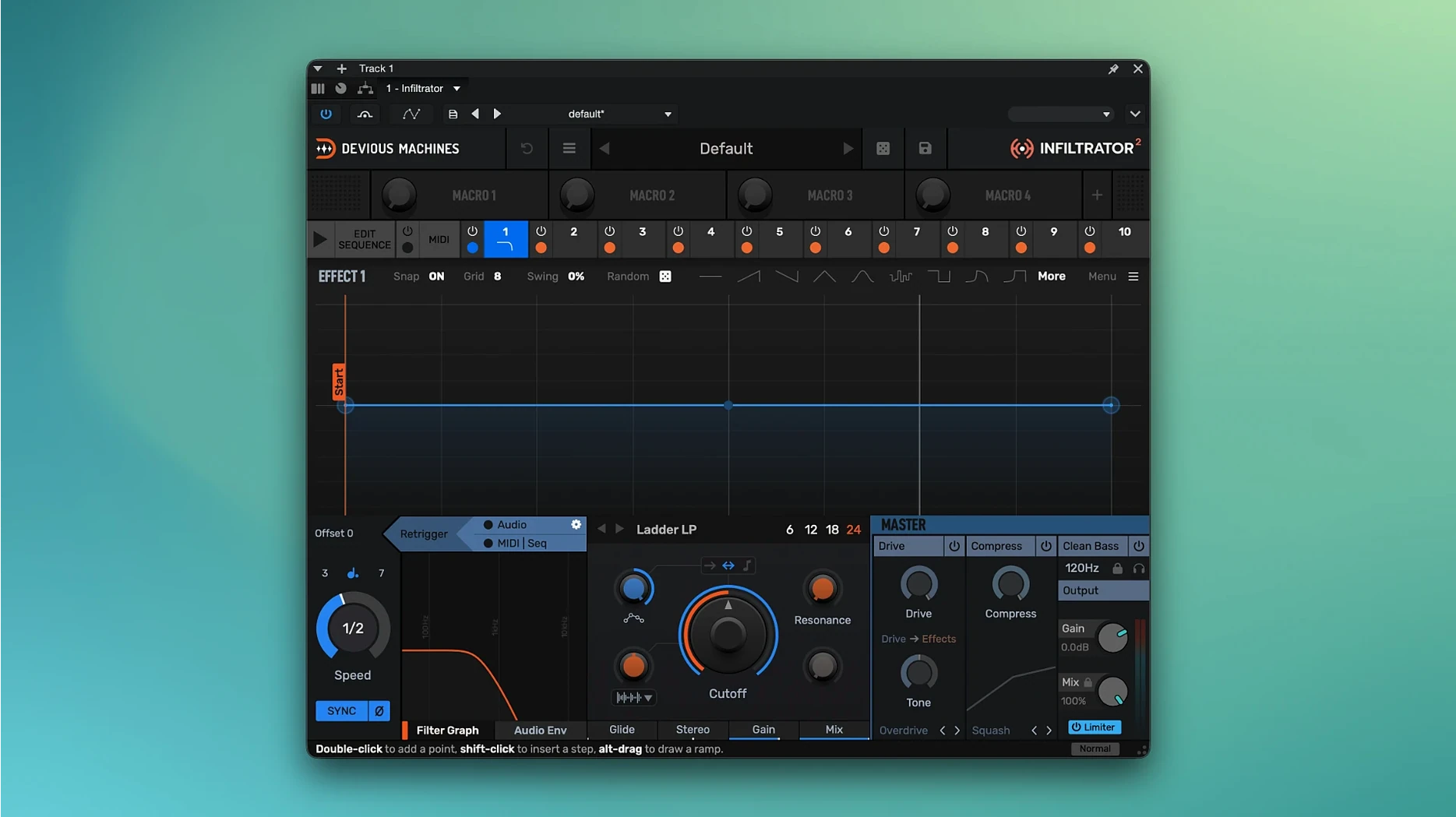
Version 2.5 landed with a couple of quiet but crucial additions: a brand-new output limiter to keep runaway modulations in check, and custom beat divisions so tempo-synced effects can groove to your own subdivisions. Those tweaks make an already deep plug-in even more planted in a real mix.
Sequenced Reverb Throws from a Single Insert
On individual channels, Infiltrator is where I go when a static EQ or one-knob filter won't cut it. Stack an envelope follower into a bit-crusher, then route a sequencer to a reverb throw — all within a single insert. Version 2 doubled the effect count and modulation options, so you're never hunting for a second plug-in just to finish a chain. It's tailor-made for turning a plain synth stab into something that ducks, spits, and breathes with the track.
On Buses and Beyond
Drop it on a drum bus or an aux return and it becomes a completely different animal. I'll feed it a full kit, dial in a liquid analog-style filter as the Russian page puts it, and let the envelope-controlled movement glue the group together with a pumping, organic feel. The new output limiter earns its keep here, stopping transient spikes before they hit the next plug-in. Whether it's subtle saturation or reality-bending transformation, Infiltrator feels just as at home on a send as it does on a channel.
A Sound Designer's Saturday Afternoon
Picture a game audio designer who needs thirty creature vocalisations by Monday. Opening a fresh project, she drops a clean field recording of a fox bark onto a track and slots Infiltrator across it. The goal isn't a subtle polish — it's a complete transformation into something alien. She stacks a pitch shifter into a comb filter, then assigns an LFO to slowly sweep the comb frequency while a step sequencer rhythmically chokes the dry/wet mix. A second envelope follower ducks the whole chain whenever the original bark peaks, preserving just enough attack to keep it animalistic. Ten minutes later she's got a rasping, chittering call that sounds nothing like the source. She bounces it, tweaks two modulator rates, bounces again, and by the afternoon coffee break she's banked a dozen variations without ever leaving the plug-in. That kind of speed — building complex, modulated effect chains inside a single window — is precisely where Infiltrator earns its keep for professionals who bill by the hour.
More Fluid Modulation Than Soundtoys Effect Rack
Producers eyeing Infiltrator are often also looking at Soundtoys Effect Rack, Output Thermal, and Arturia Fragments. Soundtoys gets closest in spirit — a rack of classic effects you can sequence and modulate — but its modulation routing feels comparatively fixed. Infiltrator's freely assignable modulators and the ability to reorder ten effects on the fly give it an edge when you want the filter envelope to also twist reverb decay and distortion drive simultaneously. Thermal specialises in gritty, interactive saturation with a lush visual feedback loop. It's fantastic for warming up a sterile bassline, yet it doesn't attempt Infiltrator's depth of step-sequenced parameter locking or the sheer variety of effect types. Fragments, on the other hand, explores granular and spectral territory that Infiltrator doesn't touch, but its modulation system is tailored to those specific engines rather than a general-purpose chain. If your sessions regularly call for chaining a vowel filter into a ring modulator and then sequencing both with custom beat divisions, Infiltrator pulls ahead. It's the Swiss Army knife where the others are specialist blades.
Pulling Back the Mix for Parallel Processing
The most common rookie mistake is loading Infiltrator and immediately scrolling through factory presets at full wet, then dismissing it as a chaos machine. The plug-in shines when you pull the mix back and treat it as a parallel processor — subtle envelope-followed filtering on a vocal bus, or just a sliver of sequenced tremolo tucked beneath a dry guitar. Crank it to 100% and you'll hear wonderful madness, but you'll miss why it lives on so many mix engineers' drum auxiliaries.
Another trap is ignoring gain staging between stacked effects. Ten slots mean ten chances to pile on level, and before the 2.5 output limiter existed, a loud resonant sweep could send your monitors into orbit. Even now, beginners often skip checking levels between slots, then wonder why the limiter clamps down hard on what should be a dynamic performance. A quick sanity check — solo each effect in the chain and watch the meters — turns a choked, squashed result into something that breathes.
Finally, new users sometimes forget that Infiltrator's step sequencer can target any parameter, not just filter cutoff. If you only draw sequencer curves for the obvious knobs, you're leaving most of the plug-in's personality on the table. Try sequencing the mix amount of a flanger, the sample rate of a bit-crusher, or the envelope follower's release time. That's when it stops being an effect rack and starts being an instrument.
Version 2.5 keeps the momentum going with a few smart additions:
- A new output limiter, perfect for catching peaks when modulation goes wild.
- Custom beat divisions, so tempo-based effects lock into your own rhythmic feel.
- macOS 10.11 or later
- Apple Silicon or Intel processor
- VST, VST3, AU, and AAX formats
Also on readers' docks
Sign in or create an account to leave a comment.
No comments yet. Tell me how it got on with your other devices.
More in VST Plugins
See all Cymatics VOXITY
1.0.0 VST Plugins
97 MB
Cymatics VOXITY
1.0.0 VST Plugins
97 MB
 Cymatics QUAKE
1.0.0 VST Plugins
1.6 GB
Cymatics QUAKE
1.0.0 VST Plugins
1.6 GB
 Effectrix
1.4.8 VST Plugins
20 MB
Effectrix
1.4.8 VST Plugins
20 MB
 elastiquePitch
2.5.0 VST Plugins
17 MB
elastiquePitch
2.5.0 VST Plugins
17 MB
 EZbass
1.3.3 VST Plugins
81 MB
EZbass
1.3.3 VST Plugins
81 MB
 EZdrummer
3.1.2 VST Plugins
786 MB
EZdrummer
3.1.2 VST Plugins
786 MB
 FabFilter Total Bundle
25.06.2026 VST Plugins
347 MB
FabFilter Total Bundle
25.06.2026 VST Plugins
347 MB
 Cableguys Snapback
1.1 VST Plugins
37 MB
Cableguys Snapback
1.1 VST Plugins
37 MB