









Download Arturia Augmented Voices for macOS
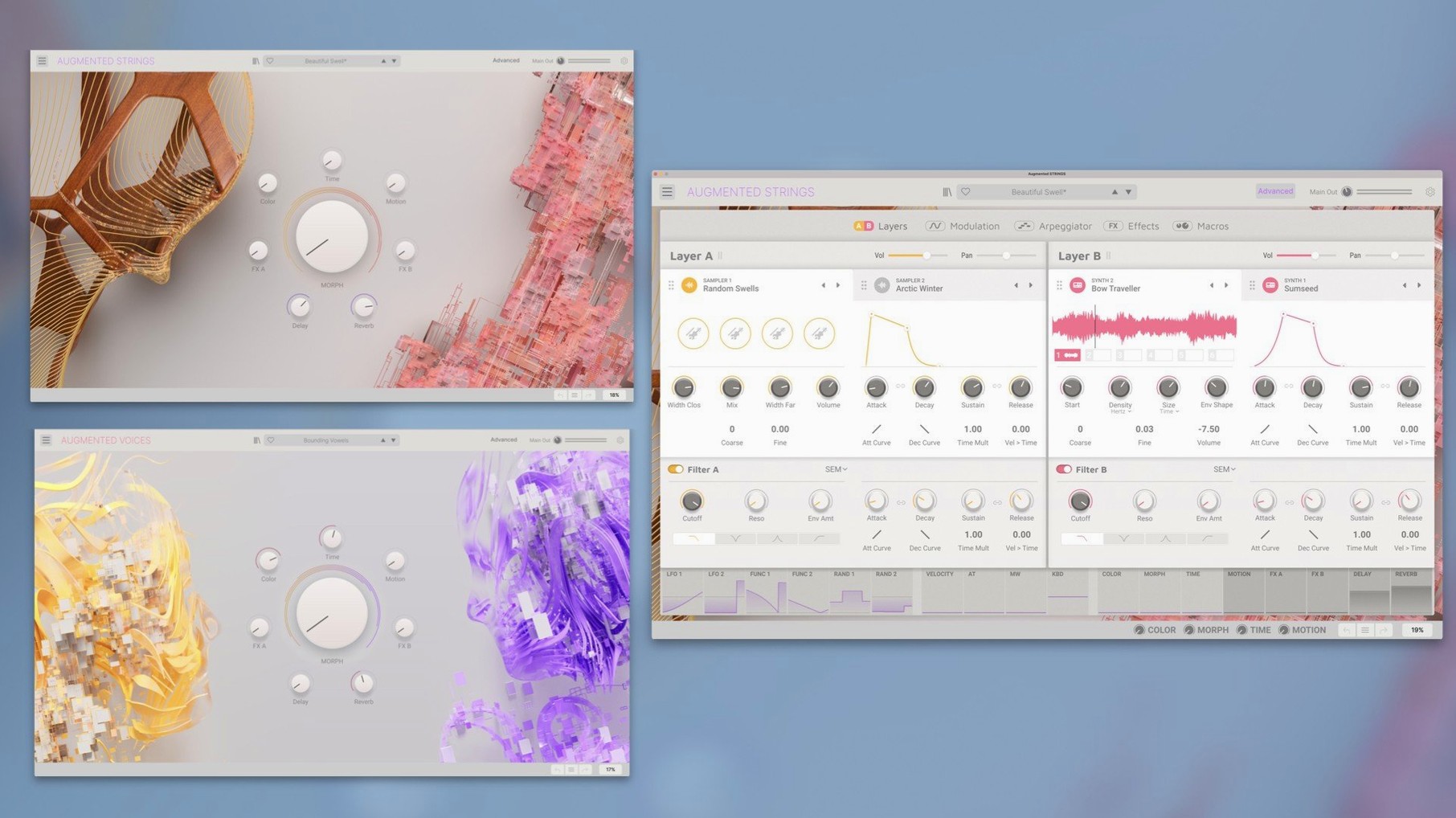
Four synthesis engines fire simultaneously inside Arturia Augmented Voices, a hybrid vocal instrument that treats the human voice as malleable synthesis material rather than a static sample. Each of its two layers pulls from a pair of sound sources—a sampled vocal phrase and a synthesized counterpart—letting you drag the Morph control to slide between earthy, recognizable timbres and glassy, otherworldly pads that still carry a ghost of the original breath.
- Morph control — a single slider crossfades the entire patch from Layer A’s organic vocal sample into Layer B’s synthesized texture. It’s not a blend knob; it’s a scene change you can automate over a bar or a whole verse.
- Four engines under the hood — granular, harmonic, wavetable, and sample engines all run at once per layer. A whispered phrase can have its attack granulated while the sustain rides a wavetable sweep.
- Built-in effects chain — two slots per layer plus a master bus. Convolution reverb on a throaty hum, then bit-crushing on the synth layer underneath, all without leaving the window.
- Advanced panel — a modulation matrix, a multi-mode arpeggiator, and per-engine parameters live behind the main view. Draw an LFO onto the Morph knob or clock a gated vocal chop to your DAW tempo.
It runs standalone or as an AU, VST, AAX, or NKS plug-in on macOS 11.0 and up, slotting naturally into a producer’s existing toolkit. The Augmented series DNA is clear here: half-acoustic, half-synthetic, and entirely about motion. If you build cues where a voice needs to shift identity across a timeline, this instrument gives you the faders to write that transformation into the arrangement.
In daily track-building sessions on an M-series MacBook Pro, the instrument loads presets without fanfare and settles into a project with the kind of CPU footprint that doesn't force you to freeze tracks the moment inspiration strikes. Layering three instances—a breathy pad, a staccato chop, and a slow-morphing drone—kept the buffer at 128 samples without crackles, even while Logic’s playback churned through twenty other channels. Memory usage sits around 1.2 GB for a fully loaded multi, which feels fair for an engine juggling four synthesis types per layer. The one spot where you notice the weight is during a rapid preset-surfing session: switching from a granular-heavy patch to a complex wavetable pad can hitch for a fraction of a second. It’s never a crash, just the engine reallocating its internal routing, and it vanishes once you settle on a sound and play.
Stability holds up across formats. AU and VST3 instances survived a six-hour arrangement session without a single dropout, and the standalone app plays nicely with aggregate audio devices when you want to run it outside the DAW for sound design sketching. On Apple Silicon, the native binary keeps thermal load low—fans stayed quiet even during a long Morph-automation pass that had both layers’ engines recalculating in real time.
MIDI routing from notation apps via IAC Driver
Augmented Voices integrates smoothly with the macOS audio stack. MIDI routing through IAC Driver lets you sequence it from a notation app like Dorico, while the NKS support means Komplete Kontrol keyboards map the eight macro knobs instantly—no manual MIDI-learn dance needed. Drag-and-drop doesn’t extend to exporting individual engine layers as audio, but the built-in effects chain covers enough ground that I rarely bounce a track raw; the convolution reverb and modulation effects stay on until mixdown.
It also plays well with Arturia’s own ecosystem. Presets sync through Arturia Software Center and show up in Analog Lab’s browser, so you can pull a voice-and-synth hybrid into a stacked keyboard patch without opening the full instrument. The Morph parameter exposes itself as an automatable host parameter in every DAW I tested, which means you can draw automation curves in Logic, Ableton, or Cubase and watch the vocal identity shift over time—no clunky workarounds, just a smooth 0-to-127 sweep that the engine interpolates without phase artifacts.
Morph control as a scene-change fader
Film and game composers who build cues around evolving textures will find the most mileage here. The Morph control is practically a scene-change fader, and writing a single held note that transforms from a real soprano swell into a shimmering harmonic cloud is the kind of thing that lands beautifully under dialogue. Sound designers chasing vocal fragments for sci-fi interfaces or creature voices get the granular engine’s surgical slicing and the per-layer effects as a bonus sculpting kit.
Bedroom producers working in pop or electronic styles can grab quick results from the macro panel—tweak Timbre, Movement, and Color without ever opening the advanced view—then dig deeper when a verse needs a pad that breathes with the vocal hook. Keyboard players who already own an Arturia controller will appreciate that the macro assignments map without friction, turning the instrument into a performance tool rather than a programming exercise. If your work involves making a voice feel less like a static sample and more like a living part of the synthesis architecture, Augmented Voices earns its place in the plug-in folder.
- macOS 11.0 or later
- Intel or Apple Silicon Mac
- AU, VST, AAX, or NKS host (for plug-in use)
Questions people ask
Does Augmented Voices work as a standalone instrument?
Yes, you can open it as a standalone application or load it inside any DAW that supports AU, VST, AAX, or NKS formats.
Also on readers' docks
Sign in or create an account to leave a comment.
No comments yet. Tell me how it got on with your other devices.
More in VST Plugins
See all Arturia Augmented STRINGS
2.0.0 VST Plugins
4.9 GB
Arturia Augmented STRINGS
2.0.0 VST Plugins
4.9 GB
 Arturia DX7 V
11.13.4 VST Plugins
475 MB
Arturia DX7 V
11.13.4 VST Plugins
475 MB
 Arturia Analog Lab V
5.12.0 VST Plugins
4.4 GB
Arturia Analog Lab V
5.12.0 VST Plugins
4.4 GB
 Arturia Efx AMBIENT
1.0.0 VST Plugins
285 MB
Arturia Efx AMBIENT
1.0.0 VST Plugins
285 MB
 Arturia Emulator II V
1.6.2 VST Plugins
700 MB
Arturia Emulator II V
1.6.2 VST Plugins
700 MB
 Arturia FX Collection
2026.02 VST Plugins
16.1 GB
Arturia FX Collection
2026.02 VST Plugins
16.1 GB
 Arturia Mellotron V
1.9.3 VST Plugins
2.1 GB
Arturia Mellotron V
1.9.3 VST Plugins
2.1 GB
 Arturia Pigments
7.0.1-6772 VST Plugins
1.8 GB
Arturia Pigments
7.0.1-6772 VST Plugins
1.8 GB