








Download Arturia Mellotron V for macOS
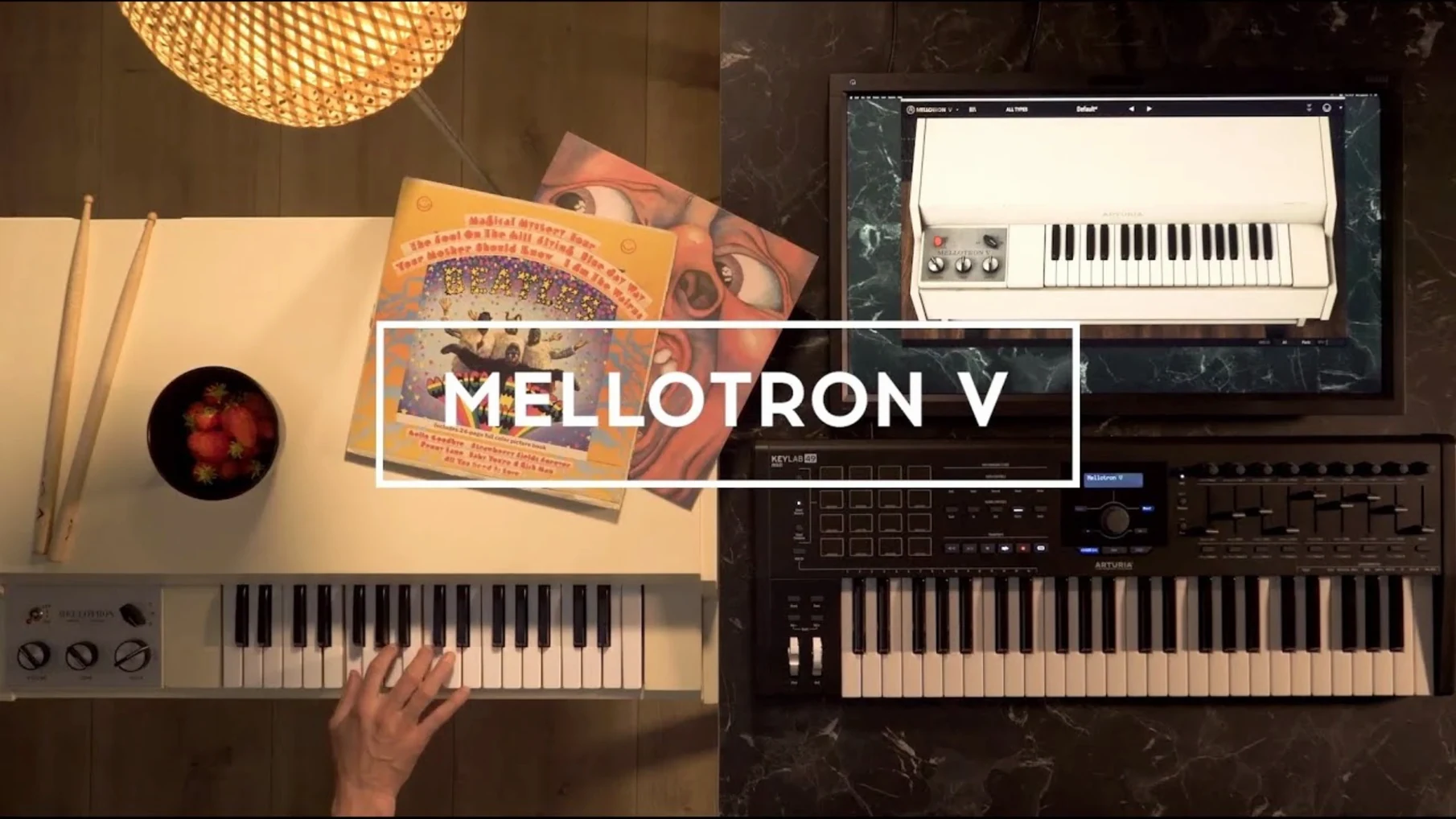
Arturia Mellotron V is a software instrument that brings the famously unstable, tape-driven character of the Mellotron into a modern plug-in.
Build a Lo-Fi String Pad
Pull up a preset from the original '3 Violins' tape bank and dial the Flutter control to about 2 o'clock. That slight pitch wobble and the mechanical key-click noise instantly place the sound in a dusty, cinematic space, perfect for a verse that needs weight instead of sparkle.
Load Your Own Tape Character
Drag a WAV file of a piano note or a vocal chop onto the interface to replace the factory sample. The engine applies the same tape speed modeling and noise profile to your custom audio, turning a clean digital recording into something that feels like it's been stored in a damp basement since 1972.
Warp the Age with Built-In Effects
Route the output through the onboard chorus and tape delay, then nudge the high-pass filter up until the low end is just a distant rumble. The result is a pad that breathes and decays unpredictably, sitting behind a mix without demanding attention.
Mellotron V vs. Other Tape-Based Instruments
If you’ve poked around the world of sampled choir and string machines, you’ve probably bumped into a few alternatives. GForce M-Tron Pro is the most direct comparison — it’s also a dedicated Mellotron emulation and ships with a huge library of tape banks. Where Arturia pulls ahead is the blend of mechanical modeling controls and the ability to load user samples without awkward workarounds. M-Tron Pro sounds gorgeous, but it doesn’t give you the same knob-per-function access to motor rumble, tape noise, and flutter that Mellotron V bakes into its front panel.
IK Multimedia SampleTron 2 takes a broader approach by covering several vintage sampling keyboards — the Mellotron, Chamberlin, Optigan, and a few oddities. Its sample import is solid, and the effects section is surprisingly deep. The trade-off is focus. SampleTron 2 spreads its attention across multiple instruments, so the Mellotron-specific quirks don’t feel as lovingly modeled. Arturia’s plug-in lives entirely inside that one machine’s personality, and you can hear the difference when you push the age controls hard.
Then there’s the matter of finding a mellotron v vst free download path that actually works. Some folks hunt down arturia mac torrent links hoping to test the waters, but cracked versions of Arturia’s stuff often ship with broken preset browsers or missing tape banks. The legit build, like the one here, includes the full 65-bank library and the preset management fixes from version 1.9.3, so your favorites actually stay sorted after a shuffle.
Expand the Palette Beyond Strawberry Fields
Does it only do the classic 'Strawberry Fields' flute sound? Not even close. The 65 tape banks cover flutes, choirs, strings, brass, and some genuinely weird combo patches. Add user sample loading and you can turn a field recording into a Mellotron pad within seconds. The factory banks are the starting point, not the whole palette.
Will it choke my older Mac? The plug-in runs on macOS 11 and up, both Intel and Apple Silicon, and it’s surprisingly light for how much modeling is happening under the hood. A single instance with effects enabled barely nudges the CPU meter on an M1 or even a 2019 Intel machine. Layering six or seven tracks might call for some freezing, but that’s true of any instrument doing real-time tape simulation.
Can I use the samples outside the plug-in? No — the banks are wrapped inside Arturia’s engine. You can import your own WAV, AIFF, or FLAC files, but you can’t export the factory tapes as raw audio. If you’ve ever searched for an arturia mellotron v free download expecting a sample pack, you’ll find this is a full instrument, not a loop library.
What if the preset browser glitches out? That was a known gremlin in earlier builds — naming a preset or shuffling favorites could crash the whole thing. The 1.9.3 update squashed those bugs, so playlists reappear after reinstalling, and the search bar actually finds what you type.
A Session with Mellotron V, Step by Step
I opened a project that needed a bridge section — something tense but not aggressive. The drums and bass were already locked, so I fired up Mellotron V on a new instrument track and started scrolling through the tape bank browser. The 'Male Choir' bank caught my ear, not for angelic pads but for a nasal, almost strained quality that felt right for the moment.
First move: I pulled the Tone control back to about 10 o'clock, rolling off the top end until the choir sounded like it was coming through a wall. Then I nudged the Flutter knob clockwise — not enough to sound seasick, just enough to make the sustain waver slightly over the four-bar phrase. That’s the thing about this instrument: the instability is the point, and a tiny flutter adjustment changes the emotional weight more than any EQ move could.
Next, I swapped one of the two factory sample slots for a user sample — a short cello stab I’d recorded months ago and never used. Dragging the WAV file onto the interface took half a second, and the engine immediately applied the same tape compression and noise profile to it. The cello sat a fifth above the choir, and the combination of the clean-ish user sample with the grimy factory tape felt like two different decades colliding.
With the sound sources set, I turned to the ADSR envelope. I stretched the release to around 1.2 seconds so the notes would bleed into each other, then opened the built-in tape delay and set it to a dotted eighth-note ping-pong. A touch of the onboard reverb — just the 'Hall' algorithm at 20% wet — pushed the whole thing back in the mix without washing it out.
I recorded the part in one take, holding chords for two bars at a time and letting the flutter do the work. After playback, I saved the preset with a quick Cmd-click on the playlist name — the 1.9.3 naming improvements meant I could type 'Bridge Choir+Cello Decay' and trust it wouldn’t crash halfway through. That preset now lives in a playlist alongside three other Mellotron sounds for the same project, and the shuffle-sorted favorites actually stay in order when I flip through them mid-session.
If you’ve ever grabbed an arturia mellotron v crack and watched the browser fall apart, that stability alone is worth the proper install. The instrument behaves like it’s part of your workflow instead of fighting it.
Version 1.9.3 tidies up several organizational corners. Preset searching, playlist editing, and favorites management all feel snappier and more predictable. Naming conventions across playlists and presets have been cleaned up, and a handful of crashes around preset browsing are now fixed.
- macOS 11 or later
- 64-bit Intel or Apple Silicon processor
Also on readers' docks
Sign in or create an account to leave a comment.
No comments yet. Tell me how it got on with your other devices.
More in VST Plugins
See all Arturia FX Collection
2026.02 VST Plugins
16.1 GB
Arturia FX Collection
2026.02 VST Plugins
16.1 GB
 Arturia Emulator II V
1.6.2 VST Plugins
700 MB
Arturia Emulator II V
1.6.2 VST Plugins
700 MB
 Arturia Pigments
7.0.1-6772 VST Plugins
1.8 GB
Arturia Pigments
7.0.1-6772 VST Plugins
1.8 GB
 Arturia Rev LX-24
1.2.1-6567 VST Plugins
403 MB
Arturia Rev LX-24
1.2.1-6567 VST Plugins
403 MB
 Arturia Efx AMBIENT
1.0.0 VST Plugins
285 MB
Arturia Efx AMBIENT
1.0.0 VST Plugins
285 MB
 Arturia DX7 V
11.13.4 VST Plugins
475 MB
Arturia DX7 V
11.13.4 VST Plugins
475 MB
 Arturia Augmented Voices
2.0.2 VST Plugins
4.8 GB
Arturia Augmented Voices
2.0.2 VST Plugins
4.8 GB
 Arturia Augmented STRINGS
2.0.0 VST Plugins
4.9 GB
Arturia Augmented STRINGS
2.0.0 VST Plugins
4.9 GB