








Download Pulsar Audio IPA for macOS
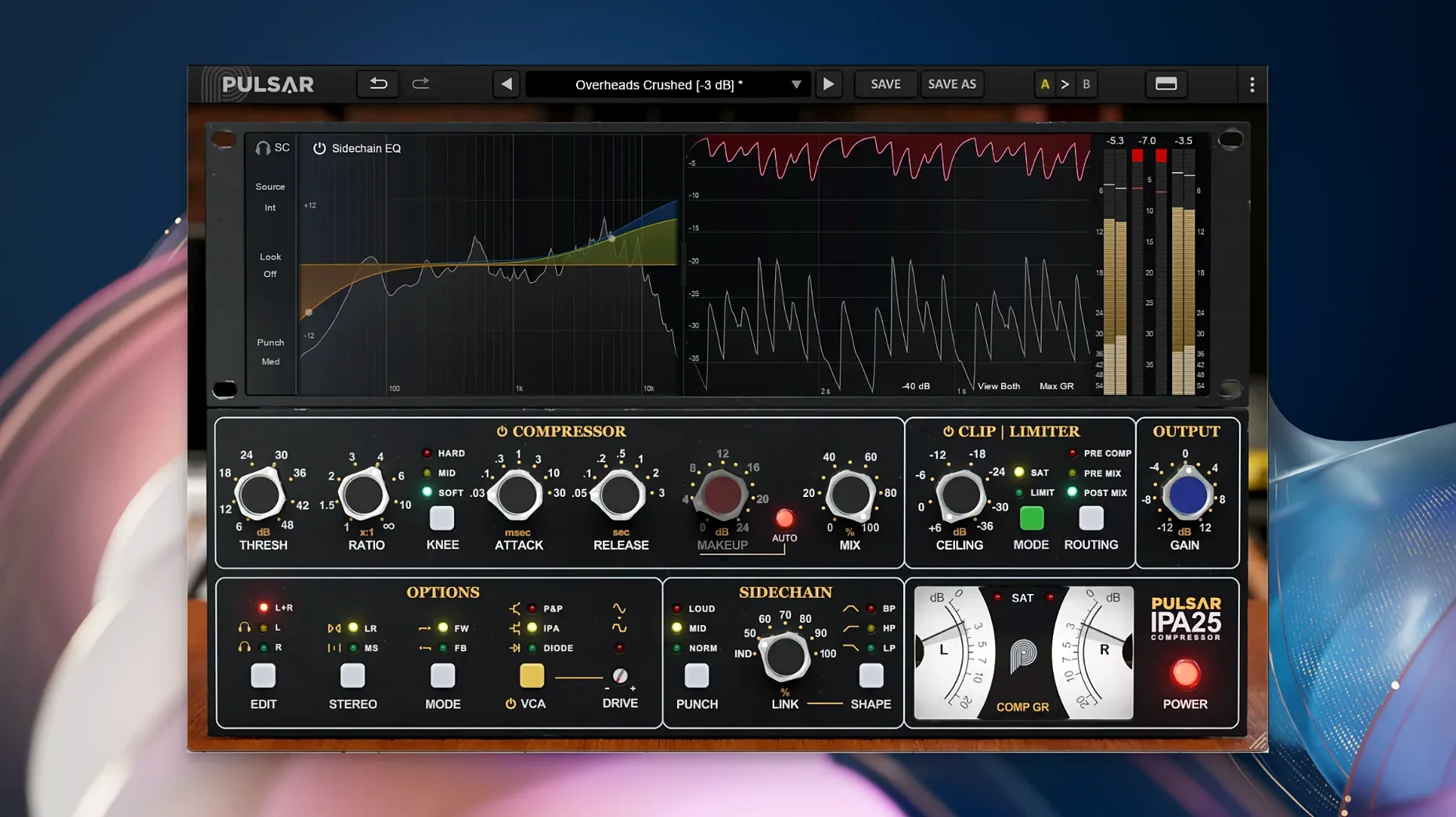
Three distinct VCA compression characters live inside one interface. Pulsar Audio IPA isn't a standalone app—it loads inside any DAW that hosts 64-bit plug-ins on macOS 11 or later—and it models its core after the revered API 2500 bus compressor. The twist is that you get three switchable modes: the punchy IPA setting, a softer P&P/Mu curve, and a more aggressive Diode option, each reshaping the grab and release of the gain reduction in its own way.
| Key detail | What you get |
|---|---|
| Plugin formats | 64-bit VST, AU, AAX |
| Standalone app | No—requires a DAW |
| Architecture | Apple Silicon native |
| Built-in tools | Clipper, limiter, sidechain visual EQ |
What makes this a proper mixing workhorse is the processing chain wrapped around the VCA core. A sidechain visual EQ lets you shape what the detector hears—pull low end out of the trigger signal to keep a bass line from pumping the whole mix, or boost a narrow band to clamp down on harsh vocal peaks. After the compressor stage, a built-in clipper and limiter catch stray transients before they hit your master bus, which means you can push into louder, denser sounds without sending a clipped signal downstream. Mid/Side processing is on board too, so tightening the stereo image or letting the sides breathe while the center stays controlled takes a couple of clicks. It fits right in on drum buses, bass lines, vocal groups, and full mixes where a little glue and a lot of attitude help.
How IPA Stacks Up Against Similar Compressors
Plenty of plugins chase the VCA bus compressor sound, but they break down into two camps: faithful one-mode recreations and multi-style toolkits. A straight API 2500 emulation gives you that one recognizable grab—fast, punchy, mid-forward—and little else. Pulsar Audio IPA sidesteps the limitation by packing three VCA personalities into the same box, so you aren't locked into a single texture for every session.
Take the pulsar audio ipa 25 approach next to something like the SSL G-Bus style. An SSL-style compressor tends to snap harder in the high-mids and can sound glassier on drum rooms. The IPA and P&P/Mu modes round off that edge, giving you more body in the low-mids and a smoother release curve that works better on bass-heavy material. The Diode mode pulls in a grittier, more saturated grab—closer to a Neve-style diode-bridge feel—without needing a separate plugin. You essentially get three hardware-inspired paths that would otherwise require three different compressors on your insert slots.
Mid/Side is another dividing line. Some vintage-inspired compressors skip it entirely or bury it behind a menu. IPA puts stereo width control at the front, paired with the visual sidechain EQ. That combination is where it pulls ahead of simpler one-knob bus compressors: you can high-pass the side signal to keep the center vocal tight while letting the drum overheads swell around it, all inside a single plugin window. If you've ever stacked two instances just to process mid and side separately, you'll appreciate having it integrated.
Fixing a Collapsing Pop-Rock Chorus
It's late evening and a dense pop-rock chorus is fighting itself. The drum bus sounds wide but flabby, the bass line disappears whenever the kick hits, and the vocal group keeps poking out in the 3 kHz range. I drop pulsar vocal studio mac torrent—that's the shorthand a friend used when he recommended it—onto the drum bus first.
First move: switch the VCA mode to P&P/Mu and set the ratio to 2:1. The needle starts moving gently. I pull the threshold down until the gain reduction hovers around 4 dB on the snare hits, then open the sidechain visual EQ and roll off everything below 120 Hz. Instantly the kick stops dictating the compression behavior. The snare and toms breathe on their own, and the cymbals don't duck every time the kick drum lands.
Next, the bass line gets the IPA mode with a faster attack—around 10 ms—and a medium release. I engage the clipper post-compressor, dialing it just enough to shave the pick attack transients without flattening the finger noise. The limiter stays off here; I want the bass to retain some dynamic push into the verse.
On the vocal group, I flip into Mid/Side mode and clamp the mid channel harder with the Diode setting. The sides get a lighter ratio and a high-pass at 200 Hz in the sidechain, so the wide doubled vocals keep their air while the center lead sits solid. A touch of makeup gain brings the whole group forward. By the time I bypass the plugin, the chorus collapses—muddy, unfocused, smaller. Re-engage, and everything locks back into place. Total time across three buses: under ten minutes.
Snappier GUI Redraws on Apple Silicon
Version 1.0.9 tightened the everyday experience in a few quiet but noticeable ways. The GUI redraws feel snappier on Apple Silicon machines—knob movements track faster, and switching between VCA modes no longer produces a slight lag that earlier builds showed on high-resolution displays. The sidechain visual EQ curve now updates in real time as you drag filter points, which makes dialing in a detector response more immediate than the stepped refresh some users reported previously.
Under the hood, the clipper stage got a refinement. In earlier versions, aggressive clipping could introduce a faint aliasing tail on sustained bass notes when you pushed past 6 dB of reduction. The 1.0.9 build cleans that up, so the clipped signal stays truer to the source even at heavier settings. Mid/Side linking also became more predictable—the stereo image no longer drifts slightly when toggling between linked and unlinked compression on material with wide low-end information. For anyone who relied on pulsar audio ipa across a full mix session, these small fixes add up to fewer trips back to re-tweak settings that wandered.
- macOS 11 or later
- Apple Silicon or Intel Mac
- 64-bit plug-in host (VST, AU, or AAX)
Questions people ask
Does Pulsar Audio IPA work without a DAW?
No, IPA has no standalone application. It requires a third-party DAW host that supports 64-bit plug-ins.
What compressor models does IPA emulate?
It's a modern take on the classic API 2500 bus compressor design, but it offers three switchable VCA modes—IPA, P&P/Mu, and Diode—each with its own character.
Can I use IPA for Mid/Side processing?
Yes, Mid/Side processing is built right in alongside a sidechain visual EQ, a clipper, and a limiter.
Also on readers' docks
Sign in or create an account to leave a comment.
No comments yet. Tell me how it got on with your other devices.
More in VST Plugins
See all Plugin Alliance Shadow Hills OptoMax
1.0.0 VST Plugins
73 MB
Plugin Alliance Shadow Hills OptoMax
1.0.0 VST Plugins
73 MB
 Plugin Alliance Brainworx Bundle
2025.06.16 VST Plugins
2.1 GB
Plugin Alliance Brainworx Bundle
2025.06.16 VST Plugins
2.1 GB
 RC-20 Retro Color
1.5.1 VST Plugins
170 MB
RC-20 Retro Color
1.5.1 VST Plugins
170 MB
 Updated reFX Nexus
5.5.21 VST Plugins
72 MB
Updated reFX Nexus
5.5.21 VST Plugins
72 MB
 Revoice Pro
5.1.30 VST Plugins
39 MB
Revoice Pro
5.1.30 VST Plugins
39 MB
 RipX DAW Pro
8.0.3 VST Plugins
1.6 GB
RipX DAW Pro
8.0.3 VST Plugins
1.6 GB
 Roland Cloud Legendary Series
2025.06.29 VST Plugins
1.3 GB
Roland Cloud Legendary Series
2025.06.29 VST Plugins
1.3 GB
 Roland ZENOLOGY Pro
2.0.7 VST Plugins
1.8 GB
Roland ZENOLOGY Pro
2.0.7 VST Plugins
1.8 GB