









Download KORG TRITON for macOS
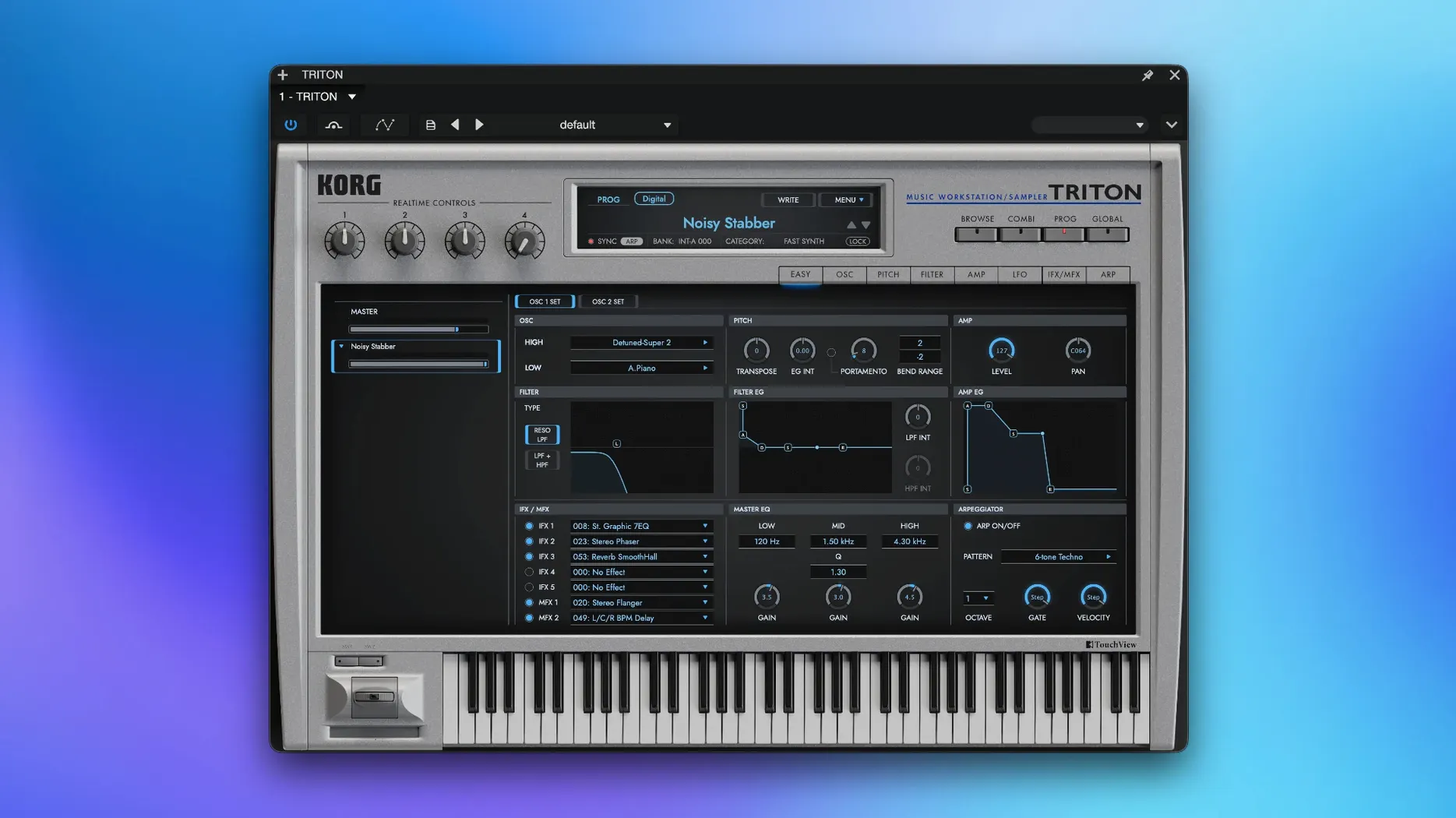
You open a project that needs a rich, evolving pad from the early 2000s, and loading the TRITON VST instantly drops that exact polished, larger-than-life tone into your track. KORG's software recreation of the 1999 workstation brings its mammoth library of more than 4,000 sounds right onto a modern Mac, running natively on both Apple Silicon and Intel processors.
Layer Sounds Like the Original
Grabbing the Combination mode lets you stack up to eight sound parts at once, just like the hardware, so you can build dense, moving textures that would take a dozen separate tracks to replicate otherwise.
Shape the Tone with Dual Filters
Dialing in a sound and flipping between the two distinct filter types gives you immediate control over the character, from aggressively cutting leads to warm, rounded basses.
Apply a Chain of Effects
Pushing a patch through the five insert effects, two master effects, and a master EQ means you can craft a fully polished, mix-ready sound without ever leaving the plug-in window.
Rescanning when the plug-in stays hidden
First launch can throw a couple of curveballs. If the plug-in doesn't show up in your DAW after installing, a rescan usually sorts it — Logic users can force a full Audio Units rescan from the Plug-in Manager, while Ableton Live folks should check that the custom VST folder points to the right location. Sometimes the standalone app opens fine but the VST version sits silent; in that case, making sure both have full disk access in macOS Security & Privacy settings clears it up fast.
Another occasional hiccup: patches loading with a burst of noise or unexpected silence. The TRITON's internal effects routing can carry over from the last Combi you loaded, so a quick tap of the reset controller button or manually zeroing the master effects sends usually brings things back to normal. On Apple Silicon Macs, a few users grabbing a KORG TRITON VST torrent have hit Rosetta oddities with older DAWs — running the host natively fixes that instantly since version 1.4.7 is a universal binary.
Chasing that glossy late-90s R&B texture
Consider a beatmaker who grew up hearing the TRITON's piano and string layers on late-90s R&B records. She's building a slow, moody track and wants that exact glossy texture without digging through sample packs. She opens the VST, pulls up a Combi that layers a stereo grand with a soft string ensemble, then swaps one of the insert effects for a phaser to give the highs some movement. Within fifteen minutes she's tracked a chord progression that already sounds like it's been through a console. What makes her stick with it is the master EQ — carving out a little low-mid mud right inside the plug-in means her rough mix already translates cleanly to her headphones before she even touches a channel strip.
First-Days Tips That Actually Help
- Audition from the Combi list first. Single Programs are great, but Combis show you how the eight-part layering engine thinks. Browsing them teaches you the architecture faster than reading a manual.
- Save a blank template Combi. Stripping one down to a single initialized part with no effects gives you a clean starting point for sound design sessions.
- Map the mod wheel early. Many of the factory patches respond to the mod wheel in dramatic ways — filter sweeps, tremolo, crossfades. Assigning it to your controller on day one opens up the presets enormously.
- Watch the insert effect slots. The TRITON's five inserts are shared across all parts in a Combi, unlike some modern workstations. Knowing that keeps you from accidentally starving one layer of its reverb because another part is hogging the slot.
Printing wet and dry stems simultaneously
Head into the preferences and adjust the output routing if your interface has more than two outputs — spreading the master effects to separate outputs lets you print wet and dry stems simultaneously. The MIDI channel assignment defaults to omni, which is fine for standalone jamming, but locking each Combi part to its own channel makes multi-timbral recording in a DAW far smoother. Also, bump the sample rate to 48 kHz if your project allows; the PCM library was captured at that rate, and running it natively avoids real-time resampling that can subtly soften the transients on percussive patches.
- macOS 11 or later
- Apple Silicon or Intel processor
- VST or standalone compatible host (for plug-in use)
Questions people ask
Can the KORG TRITON software run on an M1 or M2 Mac?
Yes, the current version has native Apple Silicon support and runs on macOS 11 and later, on both ARM and x86 64-bit architectures.
Also on readers' docks
Sign in or create an account to leave a comment.
No comments yet. Tell me how it got on with your other devices.
More in VST Plugins
See all KORG Software Modwave Native
1.4.2 VST Plugins
111 MB
KORG Software Modwave Native
1.4.2 VST Plugins
111 MB
 LANDR Mastering Plugin PRO
1.1.35 VST Plugins
365 MB
LANDR Mastering Plugin PRO
1.1.35 VST Plugins
365 MB
 LANDR Vocal Bundle
2025.12 VST Plugins
447 MB
LANDR Vocal Bundle
2025.12 VST Plugins
447 MB
 KORG Collection
1.0.3 VST Plugins
175 MB
KORG Collection
1.0.3 VST Plugins
175 MB
 Komplete Kontrol
3.5.4 VST Plugins
785 MB
Komplete Kontrol
3.5.4 VST Plugins
785 MB
 LFOTool
1.768 VST Plugins
7 MB
LFOTool
1.768 VST Plugins
7 MB
 Komplete FX Bundle
2026.1 VST Plugins
3.2 GB
Komplete FX Bundle
2026.1 VST Plugins
3.2 GB
 Kalifornia Dynamic KD Alkane
1.0.17.0 VST Plugins
270 MB
Kalifornia Dynamic KD Alkane
1.0.17.0 VST Plugins
270 MB