









Download Suzerain for macOS
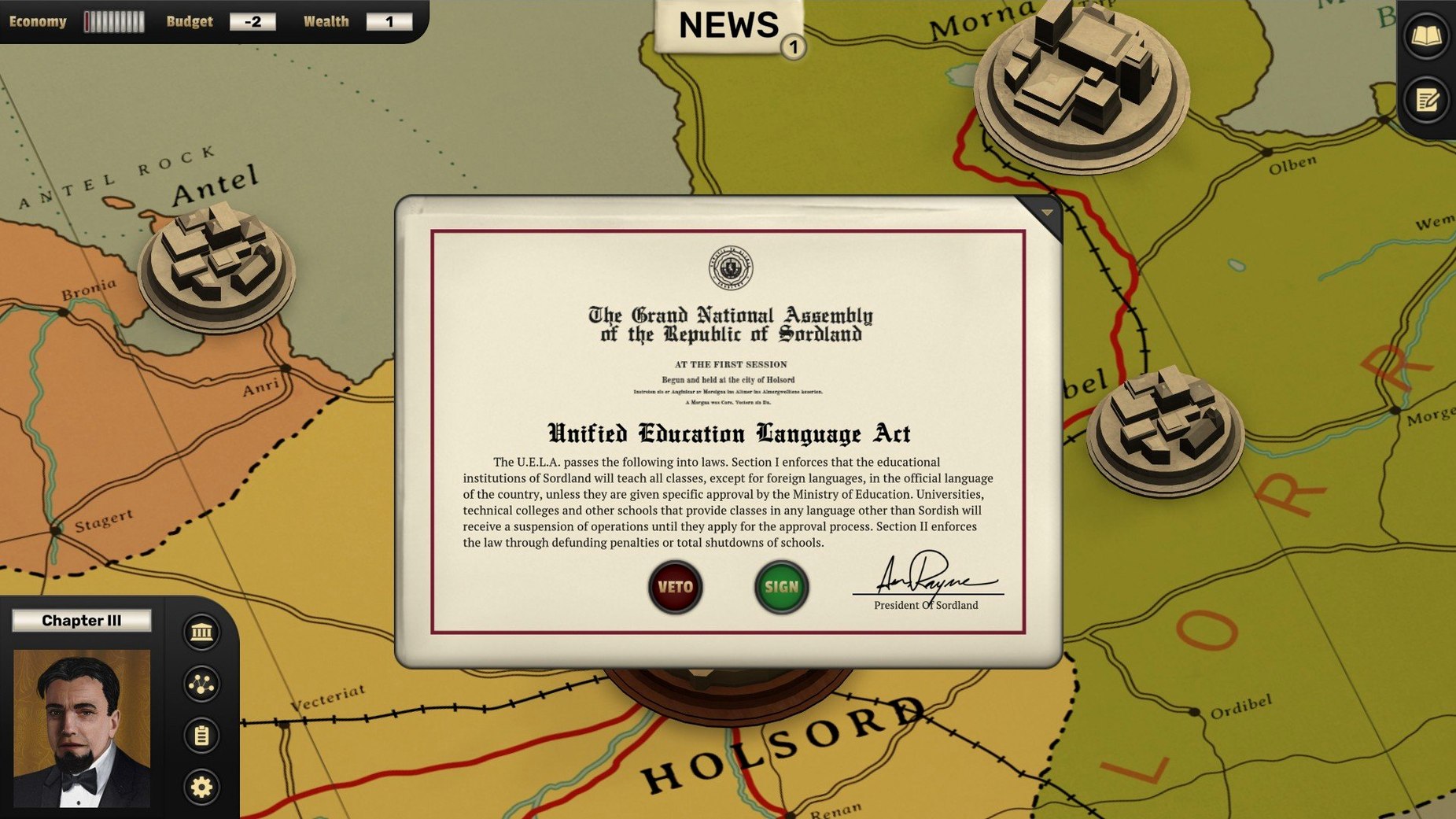
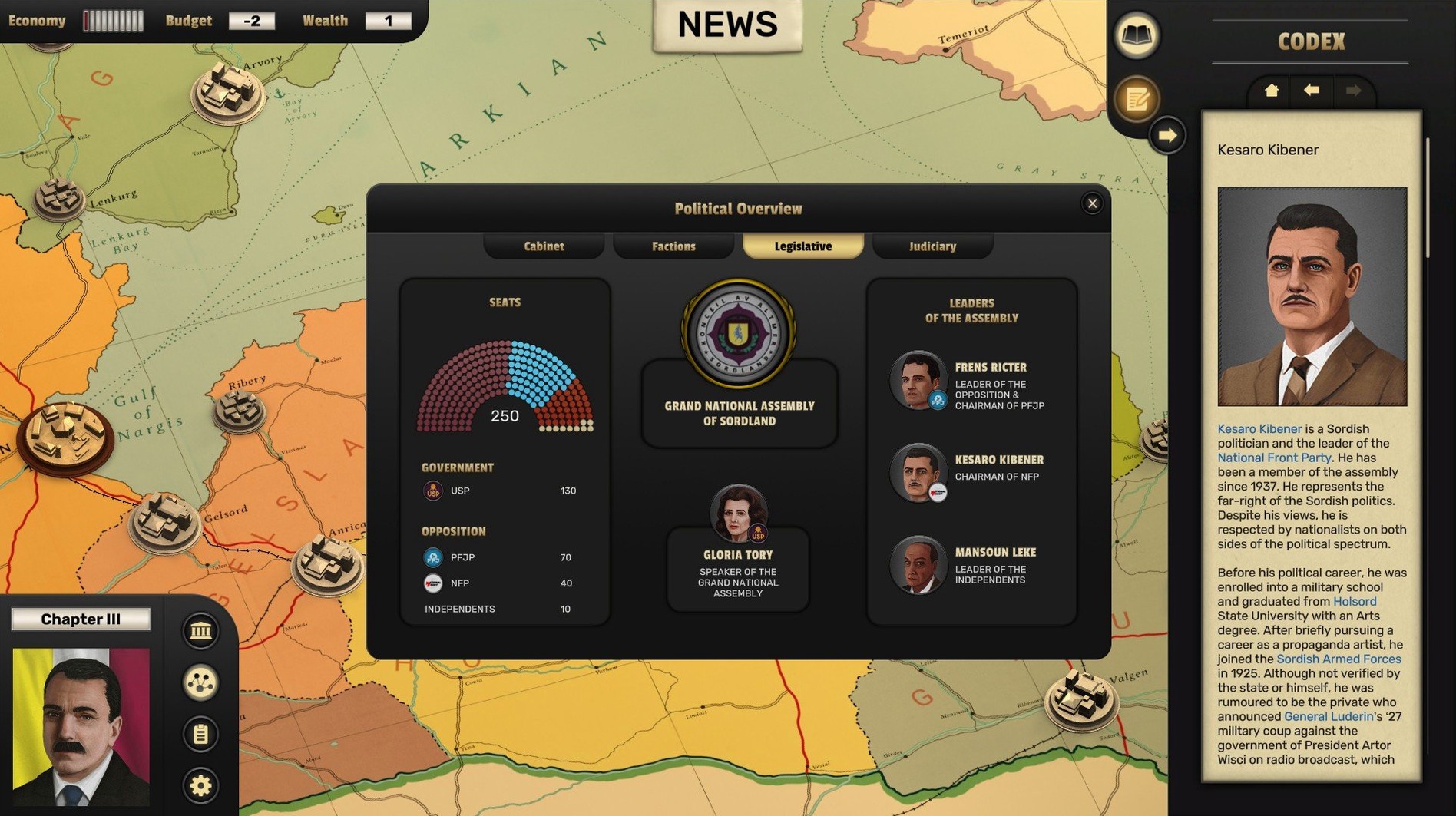
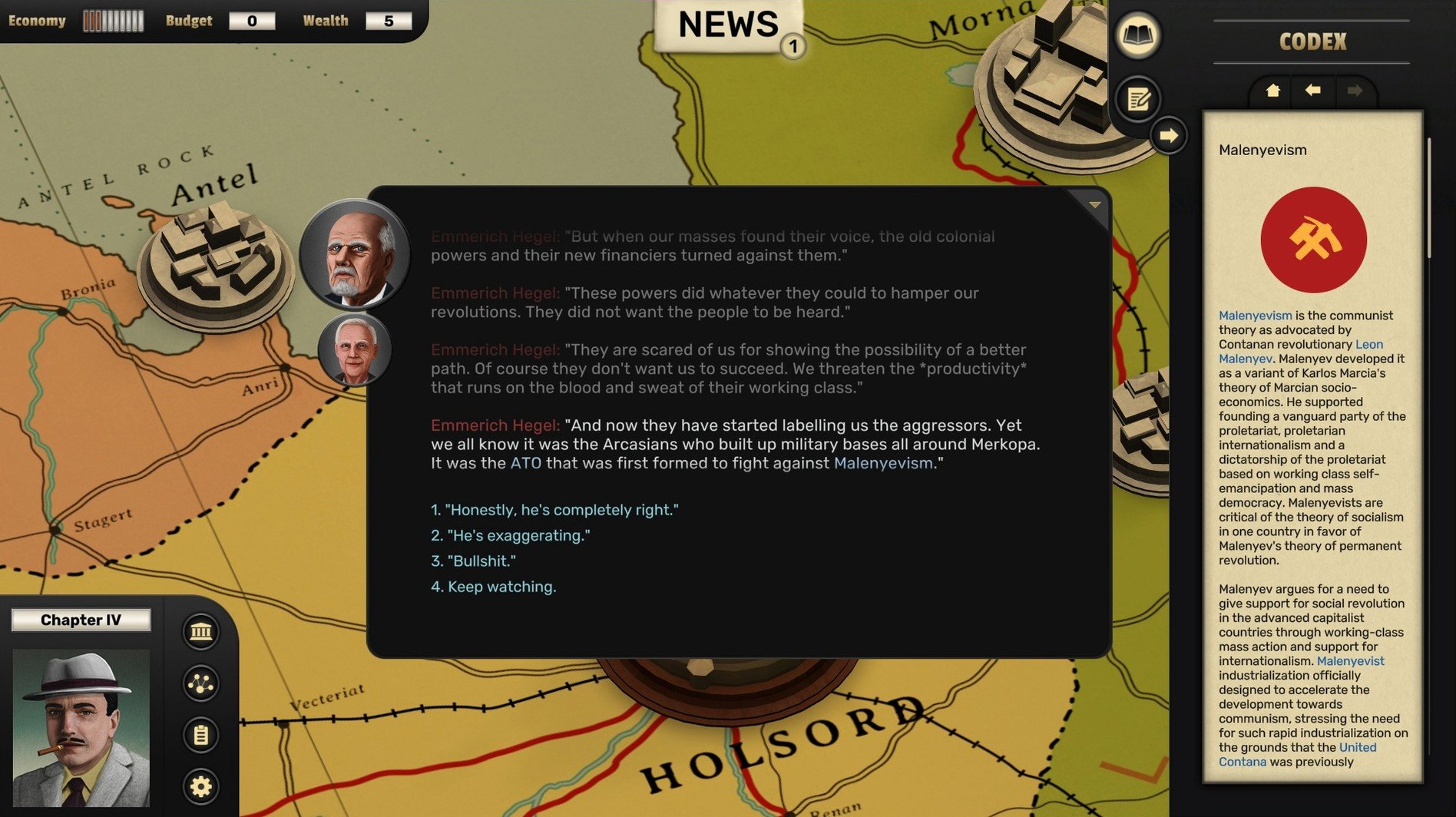
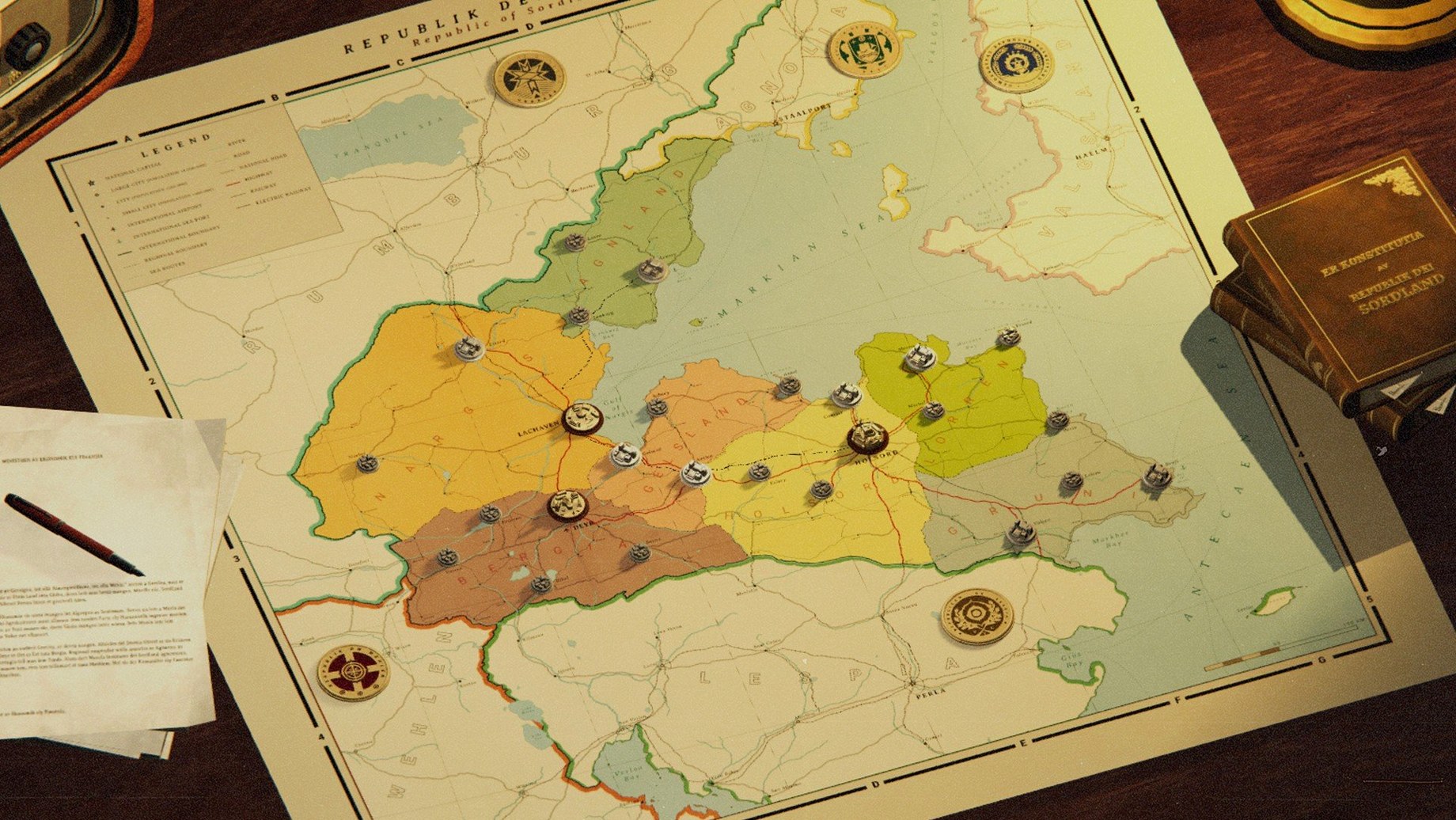
Finding a deep, text-driven political drama that doesn't feel like a spreadsheet is a rare thing. Suzerain steps into that gap by putting you in the worn shoes of President Anton Rayne, leading the fictional nation of Sordland out of a two-decade dictatorship in 1954. Every conversation with your cabinet and every signed decree pulls the country—and your conscience—in a new direction.
Running Suzerain on macOS
The game runs as a 64-bit Intel application, so Apple Silicon Macs rely on Rosetta 2, which handles it without fuss. On a Mac mini M4 under macOS Tahoe, performance is smooth throughout—the static portraits and map screens aren't taxing, and the real weight is in the branching dialogue, which loads instantly. Controls are straightforward keyboard and mouse, with no gamepad support, which fits the desk-bound nature of a presidency simulator perfectly.
The Weight of the Office
What makes Suzerain stick is how small decisions echo. A budget cut to appease an advisor might spark protests months later. Taking a bribe opens doors but closes others. The game is entirely in English and leans on its sharp writing to make cabinet meetings feel as tense as any battlefield. If you enjoy stories where your character's integrity is a resource to manage, this one lands hard.
Lives for Briefings, Not Battle Maps
If your favorite part of a strategy game is the written briefings and character interactions—not the unit placement—Suzerain will feel like it was made for you. Story-driven players who devour branching narratives and political drama get the deepest pull, because every conversation with a minister, a foreign diplomat, or a family member builds the world and tests your principles.
Mac users who prefer turn-based pacing over twitch reflexes also thrive here. You can sip coffee while deciding whether to privatize healthcare or fund rural schools, and the game never punishes you for taking your time. Those who enjoy replaying a story to see alternative outcomes will find a natural home too: a single term as president can end in triumph, disgrace, or a coup, and the fork points are genuinely hard to predict on a first run.
It's less suited to players who want sandbox freedom or flashy visuals. Sordland is a tightly authored stage, not an open world, and the drama plays out through text and static portraits. But for anyone who loves morally gray choices and political world-building, it's a standout on macOS—especially as a suzerain macos free DRM-FREE build that installs cleanly and stays out of your way.
No Real-World Politics Degree Required
Does the game expect me to understand real-world politics? Not at all. Sordland has its own history, parties, and regional tensions, and the game teaches you through briefings, news reports, and private conversations. You learn the stakes by living them, not by studying a glossary beforehand.
How long is a full playthrough, and am I locked into my early choices? A single term runs several hours, and while early decisions absolutely ripple forward, the game rarely locks you into one path without warning. You can pivot on some issues, but your reputation and relationships will remember what you did last month—that's the beauty of it.
Will it feel slow on an older Intel Mac? Since the heavy lifting is text and 2D art, even a modest Intel machine handles the suzerain macos free version comfortably. The interface is responsive and there are no real-time action sequences to stutter.
A Workflow for Surviving Your First Term
Here's how one tense early-game session might unfold, from the oath of office to a crisis meeting that tests your cabinet.
- Settle into the role. Read the opening briefing carefully—it outlines Sordland's economic slump, tense borders, and the fragile coalition that put you in power. Jot down a personal rule for your Rayne: mine refused all bribes, but kept a pragmatic trade policy.
- Tour your departments. Meet each minister one by one. I focused on the economy first, promising infrastructure investment while quietly noting which advisors seemed loyal and which were already angling for influence. Every dialogue choice nudges an invisible approval meter.
- Make your first hard call. A budget proposal lands on your desk. Do you fund education or defense? I chose schools, hoping to stabilize the countryside long-term, which delighted my education minister but earned a cold shoulder from the military chief later that week.
- Handle a surprise visitor. An opposition figure requested a private meeting. I accepted and listened without promising anything—reading between the lines revealed a scandal they were sitting on, which I could leverage or bury. I buried it, and they owed me a favor down the road.
- Respond to a border incident. A report arrives of a clash in a disputed region. My foreign minister urged a strong statement; my wife, whose dialogue often cuts through the political noise, warned against escalation. I drafted a cautious reply, which calmed allies abroad but disappointed the nationalist bloc at home.
- Reflect and adapt. Before bed (in-game, though you may find yourself doing it literally), I reviewed the day's consequences. A law I'd signed had shifted public opinion slightly, and a newspaper editorial hinted at a brewing corruption investigation. The notebook outside the game became as important as the one inside it.
That rhythm—briefing, choice, consequence, reflection—is what makes a Suzerain session feel less like a game and more like a gripping, interactive novel.
Balance tweaks, lore polish, and a handful of bug fixes keep the republic running smoothly.
- macOS (64-bit Intel, Apple Silicon via Rosetta 2)
- Intel architecture
- English language only
Also on readers' docks
Sign in or create an account to leave a comment.
No comments yet. Tell me how it got on with your other devices.
More in Games
See all STORROR Parkour Pro
0.39.0 Games
25 GB
STORROR Parkour Pro
0.39.0 Games
25 GB
 Tails of Iron 2: Whiskers of Winter
1.17494 Games
4.6 GB
Tails of Iron 2: Whiskers of Winter
1.17494 Games
4.6 GB
 Stoneshard
0.9.4.24 Games
808 MB
Stoneshard
0.9.4.24 Games
808 MB
 Stick It to the Stickman
2026.09.23 Games
895 MB
Stick It to the Stickman
2026.09.23 Games
895 MB
 Stellaris
4.5.1 Games
21 GB
Stellaris
4.5.1 Games
21 GB
 Terraformers
1.7.90 Games
1.1 GB
Terraformers
1.7.90 Games
1.1 GB
 The Battle of Polytopia
2.17.3.16375 Games
172 MB
The Battle of Polytopia
2.17.3.16375 Games
172 MB
 Static Dread: The Lighthouse
1.2.1 Games
1.8 GB
Static Dread: The Lighthouse
1.2.1 Games
1.8 GB